There’s more and more research out about how lifestyle has a significant impact on aging. This might seem obvious, but we are getting more and more data on the importance of lifestyle factors in how those in the 60+ age brackets look and feel. Of course genetics play a big role in how we age, but there are levers that we can pull to help us age as gracefully as possible. And we know a lot of people who can see the effects of this in their own families.
As one example, take a married couple we know with very different sets of in-laws when it comes to how they look and feel. One set of in-laws is in their 60s and the other is in their 70s. And the ones in their 70s are much healthier than the ones in their 60s. And while we can never really know the genetic effects, there are clear differences in how each set of in-laws lives. The ones who are healthier make conscious choices about what they eat, how they move, how they protect their skin and more. The ones in their 60s are much more sedentary. They eat a lot of processed foods and they literally never think about working out. And it has an effect!
While you’ll hear a lot of different “aging gracefully” hacks on social media, we only included habits that are backed by real evidence and data. How many of these do you do each week?
1. They Lift Heavy Things — Twice a Week

When it comes to looking better, lifting weight is one of the most important things women can do. Especially as they age. And we’re not talking about trying to look like Arnold Schwarzenegger. You’re not doing this to get jacked, you’re actually doing it more for something you can’t even see. Your bone density. (But the benefit of less flabby skin is an added bonus!) But bone density is a huge issue for women as they age. Menopause really starts to cause issues with bone density. And as people age, falls are one of the most dangerous things that can happen. But if you’ve kept up your bone density and muscle, it helps in two ways. 1) You are less likely to fall because your legs are stronger. And 2) you are less likely to break a bone if you do fall.
There was a randomized clinical trial of women averaging 65 years old called LIFTMOR. It tracked the women over eight months and had them lift twice weekly using 30-minute sessions. And it had them do 5 sets of 5 reps above 85% of a one-rep max.
What they found was spine and femoral neck density increased (2.9% and .3% respectively.) The lifters also got taller! They literally gained .2cm of height. OK, that’s not a lot, but it’s also not getting smaller.
One note, there was only one adverse event and it was a minor back spasm. So if you start to incorporate weights to your workouts, make sure you are doing it under supervision. Don’t waltz into the gym and start throwing around barbells.
“Everybody had decided the way to manage osteoporosis with exercise was to just stop falling”
— Belinda Beck, PhD, Professor of Exercise Physiology, Griffith University, and lead investigator on the LIFTMOR trial
“When menopause comes, you’re already at the edge of the cliff”
— Claudia Tamas, DPT, Director of Women’s Health at Natural Medicine and Rehabilitation
2. They Eat Protein at Breakfast — Not Just at Dinner

We all hear about how important it is to increase your protein intake as you get older to try to combat the general loss of muscle mass as we age. And everything is framed as protein grams per day. What we don’t hear enough about is when we should eat that protein. And a study out of Japan found that the earlier you eat protein in your day the better.
The problem is many women tend to eat toast, fruit or oatmeal for breakfast and then backload their protein later in the day. But the Japanese study had women eat a protein-first breakfast (3 eggs and a slice of cheese, or a cup of Greek yogurt with a scoop of protein powder, or a cup of cottage cheese…so it didn’t have to be meat-based.)
They then measured both muscle mass and grip strength of the ones who had protein first and the ones who had it earlier in the day had significantly better results. This finding goes great with the weight lifting twice a week study above. And more muscle means less flab.
“Intakes of 1.2 to 1.6 g/kg/day appear to support better muscle maintenance and adaptation”
— Stuart Phillips, PhD, Professor of Kinesiology and Tier 1 Canada Research Chair in Skeletal Muscle Health, McMaster University
“Many people, especially older adults, very likely benefit from consuming more than the RDA.”
— Stuart Phillips, PhD, McMaster University
3. They Walk — And It’s Far Fewer Steps Than You Think
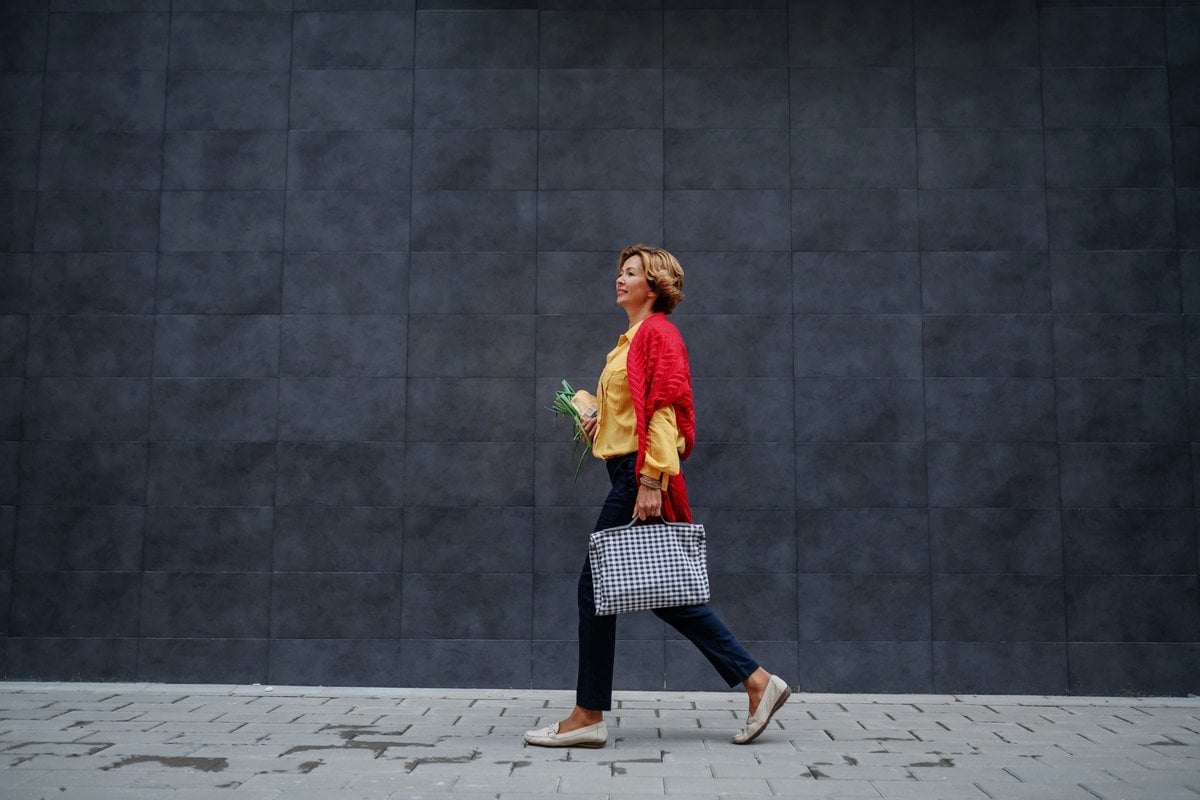
We’ve all heard the “10,000 steps a day to a better you” stuff. But the truth is…it’s not true! The 10,000 steps a day number came from a Japanese ad for a step tracker. The truth is far fewer steps each day can provide the health benefits that the 10k step plan promised.
A study that measured over 16,000 women whose average age was 72 found that just 4,400 steps per day resulted in a 41% decrease in death rate when compared to 2,700 steps per day. The benefits seem to plateau around 7,500 steps.
The other fantastic part is that the intensity of the walk didn’t really matter. Strolling seemed to have the same benefits. And the more you walk and move, the better you will look. So don’t forget the evening stroll. Or the morning stroll. (Or the lunch stroll…OK I’ll stop now.)
“Taking 10,000 steps a day can sound daunting. But we find that even a modest increase in steps taken is tied to significantly lower mortality in older women.”
— I-Min Lee, MBBS, ScD, epidemiologist, Brigham and Women’s Hospital and the study’s lead author
“Aerobic fitness is something that most patients can control. And we found in our study there is no limit to how much exercise is too much.”
— Wael Jaber, MD, cardiologist at Cleveland Clinic and senior author of a 122,007-patient fitness and mortality study
Watch: 10 research findings that decide how the decades after 50 go, in five minutes.
4. They Wear Sunscreen 365 Days a Year

This is literally the single piece of advice in this article that has the most evidence. And there are two benefits to wearing sunscreen 365 days a year. First, it will help stop you from getting skin cancer. So that’s a great benefit. But secondly, the more you protect your skin from the sun, the younger you will look. The sun is one of the things that can age your skin at an accelerated pace.
A study in Queensland tracked 903 adults who used SPF 15+ on their face, arms and hands for four and a half years. And in short, their hands aged about 24% less than those who didn’t use sunscreen every single day.
One important thing to note about sunscreen. It does not make your skin look younger. It slows down the aging damage that the sun causes.
“This has been one of those beauty tips you often hear quoted, but for the first time we can back it with science: protecting yourself from skin cancer by using sunscreen regularly has the added bonus of keeping you looking younger”
— Adele Green, Professor, QIMR Berghofer Medical Research Institute and senior author of the Nambour trial
“And the study has shown that up to middle age, it’s not too late to make a difference.”
— Adele Green, Professor, QIMR Berghofer Medical Research Institute
5. They Use a Retinoid — And They Started Slow

You see a lot of marketing claims in the skincare aisle. But one that actually works according to eight randomized clinical trials is retinoid (and tretinoin). In short, these eight randomized trials gave over 1,300 people a cream with tretinoin in it and a placebo with nothing in it. And the tretinoin one was scored just under half a point better by dermatologists on fine wrinkles when it came to measuring wrinkles. A significant measuring.
On the downside, some participants saw some reddening and inflammation. So there’s a chance that this can cause some irritation in your skin. Which is why we recommend starting slow to see how your skin reacts.
Also, retinoids are not for use if someone is pregnant. Typically not an issue in an article for 65-year-olds (lol) but we wanted to flag this in case you forward it to someone who may be pregnant.
“Many patients want to start right off with tretinoin, but I advise them to use the least-intense retinoid formula they can find, and use it every other night to start, slowly building up.”
— Tina Alster, MD, FAAD, board-certified dermatologist and clinical professor of dermatology, Georgetown University Medical Center
“With skin of color, irritation can trigger dark marks, known as hyperpigmentation. However, starting slowly and using moisturizer will help mitigate this possibility.”
— Sonia Badreshia-Bansal, MD, FAAD, board-certified dermatologist, Danville, California
6. They Treat Sleep Like an Appointment

This is the cheapest finding in this article. Sleep is free! And it is super important because it helps your body recover. And that includes your skin. A Cleveland sleep study took two sets of women, sorted by the Pittsburgh Sleep Quality Index into good sleepers and bad sleepers, and stripped their skin barrier with tape. Then they found that women who were good sleepers had their skin recover from having its protective barrier stripped 30% more than the bad sleepers after 72 hours. But that wasn’t all. The bad sleepers’ skin actually got worse (-6%.) The good sleepers also recovered from a sunburn faster after 24 hours.
This study was paid for by Estée Lauder, for what it’s worth. But there’s enough data out there that bedtime can be up there with exercise when it comes to looking your best. They didn’t call it “beauty sleep” for nothing.
“Sleep deprived women show signs of premature skin aging and a decrease in their skin’s ability to recover after sun exposure.”
— Elma Baron, MD, Director of the Skin Study Center at UH Case Medical Center and Associate Professor of Dermatology, Case Western Reserve University School of Medicine
“Our study is the first to conclusively demonstrate that inadequate sleep is correlated with reduced skin health and accelerates skin aging.”
— Elma Baron, MD, Case Western Reserve University School of Medicine
7. They Keep Their People Close

OK, this one may be a bit more about vibe than about erasing wrinkles. A huge study of 308k+ people found that stronger social relationships were associated with 50% greater likelihood of survival. This goes back to those Blue Zones findings that the people who lived the longest and most active and with it lives had good social groups.
And when you’re active and engaged with people. And that may even include flirting, you have a bit more sparkle than those who are shut ins. Loneliness can drag a person down and turn them into a bit of a Debbie Downer. And that impacts not only the way you carry yourself, but how others see you. Friendships can get harder to maintain after you turn 50, but it’s worth putting in the extra effort.
“We wanted to know: Does it vary by country (It does not!)? Does it vary by cause of death (Doesn’t matter!)? Is it stronger for men vs. women (Equally strong!)”
— Julianne Holt-Lunstad, PhD, professor of psychology and neuroscience, Brigham Young University, and lead author of the meta-analysis
“Someone can be lonely but not isolated, or isolated but not lonely.”
— Julianne Holt-Lunstad, PhD, Brigham Young University
What an Actual Week Looks Like
| Habit | The dose in the research | What it was measured against |
|---|---|---|
| Lift heavy | 2 × 30 min a week, 5 sets of 5, supervised | Spine bone density, posture, function (LIFTMOR RCT) |
| Protein at breakfast | ~25 g in the morning; 1.2–1.6 g/kg a day | Muscle mass and grip strength |
| Walk | ~4,400 steps a day; flat after 7,500 | All-cause mortality in 16,741 older women |
| Sunscreen | SPF 15+, every day, face and hands | 24% less measured photoaging over 4.5 years |
| Retinoid | Mildest formula, every other night, build up | Fine and coarse wrinkles across 8 RCTs |
| Sleep | Consistent, good-quality nights | Skin-barrier and UV recovery; intrinsic aging score |
| Your people | Strong ties, maintained on purpose | 50% greater likelihood of survival |
The Bottom Line
Many of the things on this list are free or close to free. And they can have a holistic impact across the way you look and feel. More muscle and tone, better protected skin, a little spring in your step. All these things go towards feeling better about yourself. And that goes a long way to looking better to those around you. Plus there’s the added benefit of making yourself healthier to boot!

Dr. Neil Shah is a licensed physician practicing in Southern California. A prolific research scientist committed to both academic medicine and clinic medicine communities, Dr. Shah has received several awards from the start of his medical career including a full-ride merit scholarship to cover his tuition in medical school at the University of Wisconsin in Madison, where he graduated in 2018.
Is your neighborhood healthy?
Get a free report on your tap water, air quality, walkability and more