Listen up ladies. Something happens when you hit fifty. Well, a lot of things happen, but today we’re only going to focus on the way your body holds onto muscle. And surprise surprise it doesn’t hold onto it better! In fact, once you hit 50 you need to consume more protein so you don’t lose muscle mass. The fancy name for it is “anabolic resistance” but what it really means is that you have to eat more protein just to stay the same. So the quick coffee and toast and protein free salads you used to have for lunch aren’t going to cut it anymore. You need to think about how you can add protein to every meal. It doesn’t have to be animal protein (lentils might just become your best friend), but you need to start adding some to every meal.
To give a little more context, dietitians suggest older adults get 1-1.2 grams of protein for every kilogram of weight per day. Younger adults need to get .8 grams per kg per day. So we’re talking a 20-30% increase in the amount of protein you’re supposed to be eating. So try to ballpark around 25-30 grams of protein per meal. That sounds like a lot…and it is. You don’t want to turn into Rocky Balboa drinking a glass of raw eggs.
The good news? Smoothies, which most people don’t really think of as sources of protein can actually provide you a ton of protein. And most of them don’t require tossing in a bunch of protein powder. You can get a lot of protein from a lot of plant-based sources. And these smoothies can fill the gap and sometimes provide all the boost you need to keep your muscle mass.
The Formula That Makes a Smoothie Actually Filling
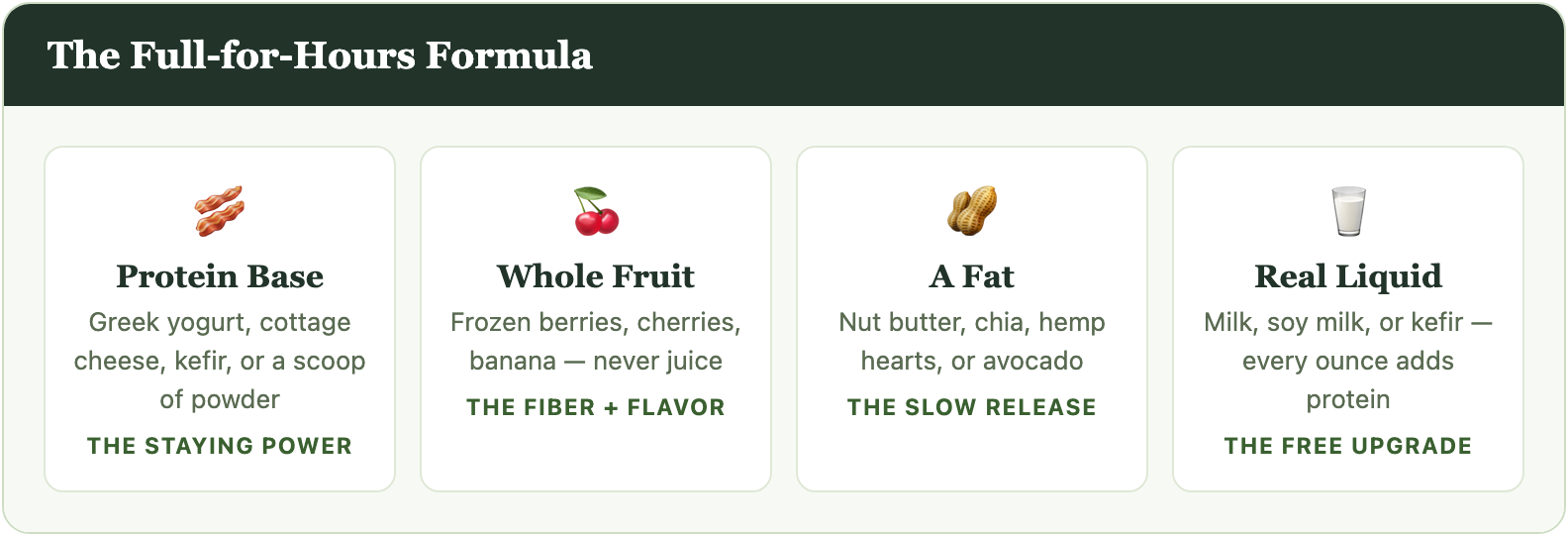
To make things easier, we like to think about every smoothie like you’re building a house. You need a real protein base to do the heavy lifting. This can be yogurt (ideally Greek), cottage cheese, kefir or a scoop of protein powder in a pinch. Then on top of that foundation we like to add a nice little whole fruit floor. The whole fruit add both fiber and sweetness. And frozen fruit is perfect for this. Because not only does it last forever, it often has higher antioxidants than fresh fruit. And the frozen stuff doubles as your ice. Then one more layer of fat to keep the fruit’s sugar spike from spiking. Things like nut butters, chia seeds, hemp hearts, a bit of avocado are all great choices here. And then last but not least, some kind of healthy liquid. Milk, soy milk or kefir are great protein back liquids. Water, sadly, has no protein.
The protein is there for the obvious reasons, but the fiber keeps you full and the fat let’s it all release slower into your system keeping you fuller longer. If you drop any one of those components you’ll be hungry and hour later.
Before the recipes, play with the combinations yourself. Tap one from each row and watch what happens to the number.
1. The Peanut Butter, Blueberry, and Banana Classic (about 30g protein)
It feels like this could be the first smoothie ever invented. There’s just something about these flavors that go together perfectly. The typical recipe is three-quarters of a cup of plain Greek yogurt, a cup of milk, two tablespoons of peanut butter, a handful of frozen blueberries, and half a banana. If I had a favorite, it would be this one. It works so well because the peanut butter makes it rich and satisfying, while the blueberries and banana are a pefect flaor match of sweet and tart. While the almond butter works better than peanut butter (but peanut butter is great too! One note: nut butters generally have a lot of calories. So make sure you don’t overdo it.
2. Chocolate Cherry (about 30g protein)
One of the greatest things science has taught us is that chocolate can actually be healthy. Yes, we’re talking about real cacao dark chocolate and not the milk chocolate candy bars you grew up with, but no one’s complaining. To make this is simple, just take a scoop of chocolate protein powder, a cup of milk, a cup of frozen dark cherries, and a teaspoon of cocoa powder if you want it darker. It kind of tastes like a dessert, but actually acts like a meal. And can we take a moment to appreciate frozen cherries. It feels like they are criminally underrated. And they work great in smoothies because they bring a deep, intense flavor, a nice bit of fiber, and they blend into a texture that feels indulgent. And they’re kinda fancy, right? If you tell someone you’re making them a cherry chocolate smoothie you will have a friend for life.

3. Strawberry Cheesecake, Without the Cheesecake (about 28g protein)
I’m going to be honest, sometimes the marketing of smoothies are kind of…wrong. Not all smoothies taste as good as the names the local smoothie store gives them. But this one actually does taste like cheesecake. To make it all you need is three-quarters of a cup of cottage cheese, half a cup of milk, a hefty cup of frozen strawberries, a splash of vanilla, and a squeeze of honey if the berries need help. Some people like cottage cheese and some people hate cottage cheese. Even if you’re a hater, I would suggest trying it at least once. And only because cottage cheese curds tends to disappear completely when blended. Leaving behind a thick, creamy texture and one of the highest protein counts you can get from a whole food. Better yet, give this to someone who claims they hate cottage cheese. But don’t tell them in it’s in there until after they tell you this is the greatest smoothie they ever had.

4. The Green One That Actually Holds You (about 30g protein)
Green means health, right? Hey, we’re not called The Greenest for nothing. And sometimes you don’t feel like drinking a cheesecake at 3pm on Tuesday. If you’re looking for something lighter, this is the one for you. To make it just toss a cup of plain Greek yogurt, a big handful of spinach, a cup of frozen pineapple, three tablespoons of hemp hearts, and enough milk to loosen it into a blender. Most green smoothies taste like grass trimmings because they’re fruit and spinach and nothing else. But when you add yogurt and hemp hearts it takes it to another level. And the pineapple does a great job of hiding the spinach aftertaste.

5. Coffee Banana Breakfast (low 30s, grams of protein)
Most of the other smoothies on this list are kind of classics or approximations of other things (hello, cheesecake.) This one is a bit different. It’s not a classic breakfast pairing, but somehow it still works really well. And it a nice little shift from the typical dark fruit-based smoothies (blueberries, raspberries etc). To make it, grab a scoop of vanilla protein powder, a cup of cold coffee, half a cup of milk, a frozen banana, and two tablespoons of rolled oats and toss them in the blender. It’s basically your coffee and breakfast all in one glass. The coffee perks you up and the rolled oats keep you full until lunch. If you can make your coffee the night before this is the quickest and fastest smoothie to make on this list. Like literally it’s done in 90 seconds.
6. Raspberry Vanilla Chia (about 35g protein)
Pudding for breakfast? Yes please. If you’ve been on Instagram I’m sure you’ve seen a million influencers making overnight chia pudding. This is sort of like that except you don’t have to do it overnight. You just have wait five minutes. And you also get to drink your pudding. To make it get y ourself a cup of plain kefir, a scoop of vanilla protein powder, a cup of frozen raspberries, and two tablespoons of chia seeds and throw them in the blender. This smoothie surprising has the most protein of any smoothie on this list. It’s becuase the chia seeds have more protein than most people realize. Let this rest for five minutes before drinking. But this is basically a pudding. It’s fantastic.
The Three Mistakes That Turn a Smoothie Into a Snack
- Making a fruit-only smoothie: Fruit juice and ice will not keep you full. There’s also no protein so you’re kind of defeating the purpose here. Plus, those really aren’t that great for you at the end of the day and they’ll definitely give you that sugar crash an hour or so later. Speaking of, we went over breakfasts that keep your blood sugar steady all morning.
- Using Juice concentrates: Adding fruit juice concentrates in an attempt to add more flavor is always a mistake. It just add more sugar and then you end up using less fiber friendly fruit. Make sure any liquid has protein in it!Blending your fruit with fruit juice concentrates the sugars and strips the fiber advantage that made the smoothie worthwhile. Milk, soy milk, or kefir add protein with every ounce; juice adds none.
- Buying a bottled smoothie: Bottled smoothies are typically just sugar bombs. They sound healthy (and some may be OK!) but you really need ot look at the ingredient list. And c’mon, at the end of the day the smoothie you make yourself is the best possible smoothie you will ever have. You know exactly what’s in it and you can make exactly how you like it. All it takes is a teeny tiny bit of planning. Speaking of healthy sounding foods in the grocery store that have tons of sugar, check out our breakdown of health foods with more sugar than a candy bar. We names names, and (spoiler alert) there are a lot of smoothies on that list.
Making It a Habit
Now you’ve got your smoothie building blocks plan. And you can use these as a guide. Make any smoothie you want using any flavors you want. It’s a great way to rethink all you smoothie options. Tell us which smoothies you make. We love hearing about new flavor combinations.

Joseph has been writing and editing for a wide variety of publications over the last decade. He loves covering news in the health and wellness space and has written extensively about all aspects of wellness for a wide range of publications.
Is your neighborhood healthy?
Get a free report on your tap water, air quality, walkability and more