

You may have heard the term hormone-balancing attached to several products in the wellness industry and thought, ‘Maybe that’s why I’m struggling with XYZ!’ But while hormones are gaining traction in the overall health space and are vital pieces of the overall puzzle, the many claims heard that blame them for all health problems and promise a magic fix are completely unfounded.
That said, research into hormones, their effects, and what affects them continues to grow, giving us a clearer picture of what they can and can’t do. Some foods, in particular, may help foster improved hormonal health, and with the credible evidence to prove it, you may just find some benefit in adding in some or all of the foods that can help you get to where you want to be health-wise.
What food can and can’t do to your hormones
We must preface this entire conversation first by saying that no single food is a magic potion that can fix your hormones.
It’s not about the food itself. It’s about what the food provides that gives your body a boost to get to balancing on its own. Even superfoods can’t help you outrun lifestyle habits or physiological changes that wreak havoc on hormonal health.
That said, there are a few things that specific foods can provide that act as a tool in your journey toward better hormonal health.
Estrogen
Flaxseeds · Whole soy foods · Cruciferous vegetables

1. Flaxseeds
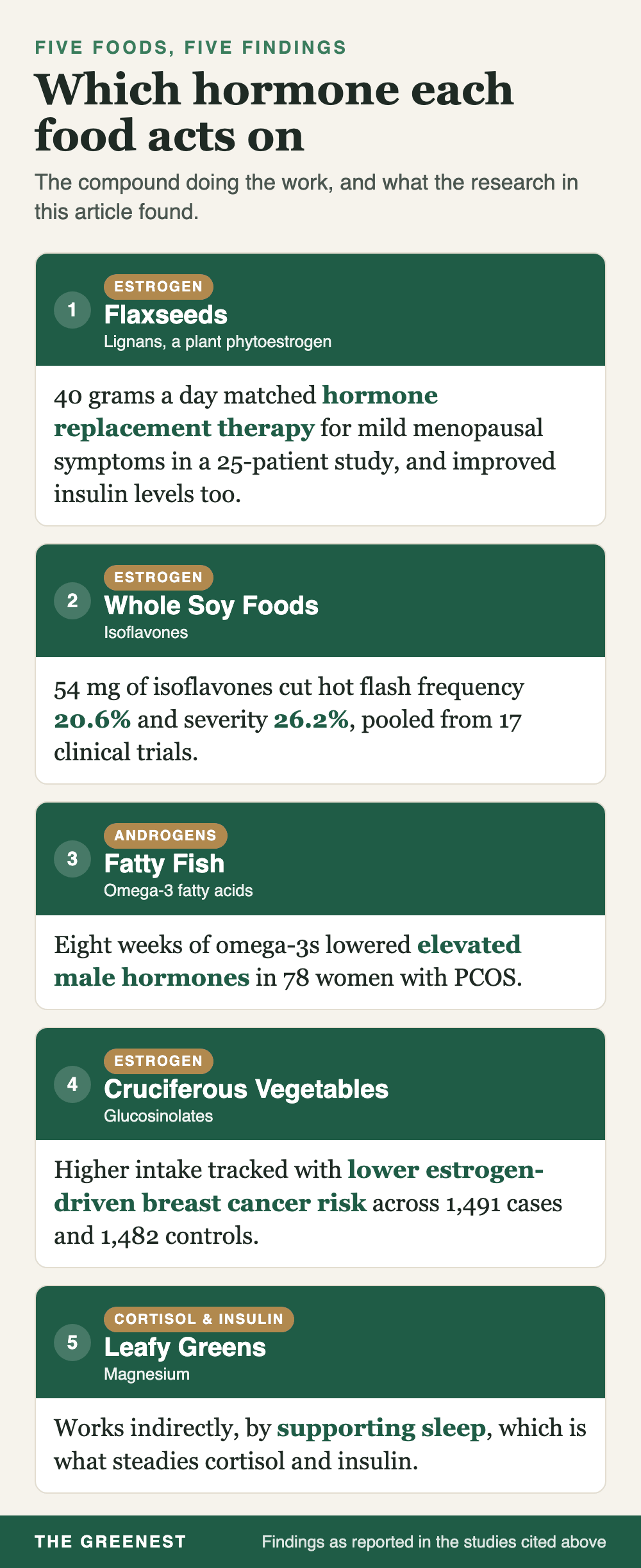
Flaxseeds are full of good-for-you nutrients, but when it comes to hormonal health, the most notable is lignans, a type of plant compound that acts as a phytoestrogen, which is basically just the official term for compounds that mimic estrogen in the body.
One research study investigated the effects of flaxseed against traditional oral hormone replacement therapy (HRT) for mild menopausal symptoms in 25 patients and found that eating 40 grams of flaxseeds per day was equally as effective as HRT.
This estrogen-balancing effect was also found to improve levels of the hormone insulin in the patients as well, working as a dual-effect agent.

2. Whole Soy Foods
Soy foods, including tofu, tempeh, and edamame, contain a form of phytoestrogen known as isoflavones. These compounds also mimic estrogen in the body, though perhaps not as strong as the lignans found in flaxseeds.
Researchers sought to find exactly how these foods could be applied as complementary menopausal care and found, in a meta-analysis of a mix of randomized controlled trials, that consuming 54 mg of isoflavones was helpful in reducing hot flashes frequency and severity by 20.6% and 26.2%, respectively. The study pulled data from 277 publications and 17 clinical trials.
While the study used concentrated isoflavones to garner their results, whole soy foods still contain these compounds, albeit in smaller amounts.

3. Cruciferous Vegetables
When looking at cruciferous vegetables and hormone balances, we have to look at research that examines the plant compounds and what they do for the body. One research study examining breast cancer risk found that those who ate more cruciferous vegetables had a lower overall risk of developing estrogen-driven breast cancer, specifically broccoli and cauliflower.
The case-control study monitored thousands of patients and their intake of cruciferous vegetables from 1982 to 1998. Then, 1491 patients who had been diagnosed with breast cancer and 1482 who acted as controls, randomly selected from a group of over 8000 participants, were compared against their intake, and it was found that those who ate more of the vegetables had a reduced risk.
It’s hypothesized that glucosinolates, plant compounds that break down into other compounds, help stabilize estrogen by affecting estrogen metabolism. These compounds transform estrogen into safer, less active forms in the body.
In a small study of 34 healthy postmenopausal women, aged 47 to 77, researchers looked at the connection between these compounds from cruciferous vegetables and found that while it doesn’t directly reduce estrogen, it can encourage more optimal estrogen breakdown within the body. It’s important to note that the results showed a small positive trend, so more research would be needed to further confirm these findings on a larger scale.
Androgens
Fatty fish
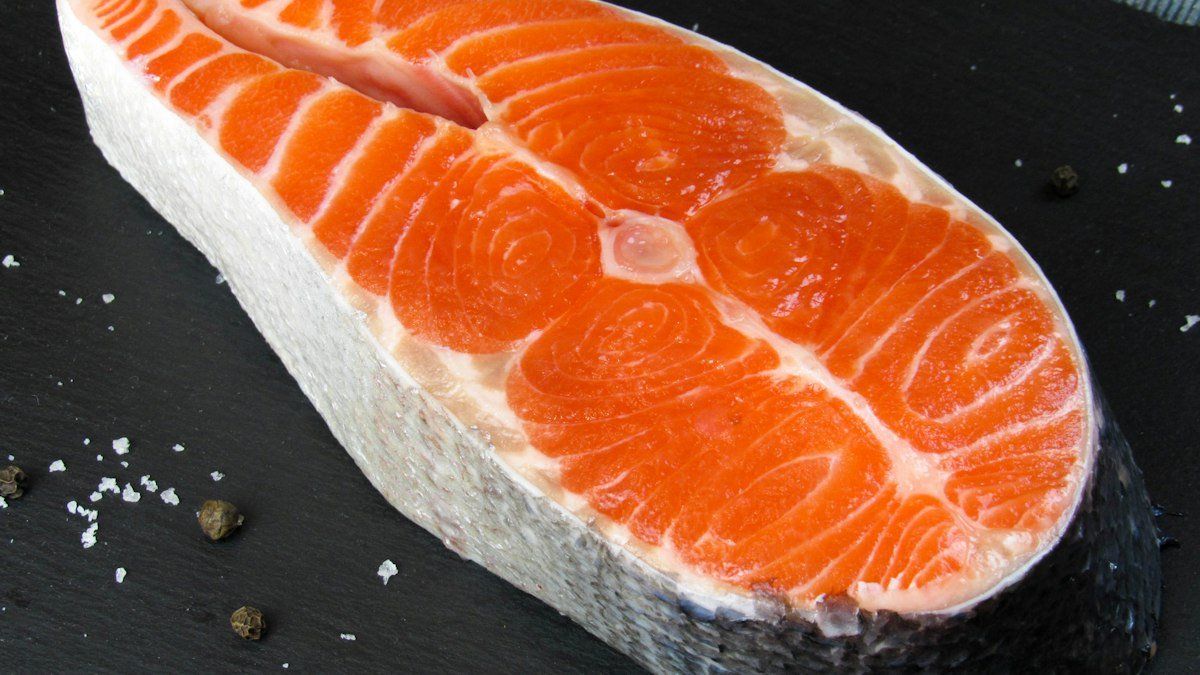
4. Fatty Fish
Fatty fish can encourage better hormonal balance because of the omega-3 fatty acids. Dietary sources of these nutrients are limited, and fatty fish is among the top choices when it comes to getting enough without turning to supplements.
When it comes to sex hormones, one study examined how omega-3s work in women with polyendocrine metabolic ovarian syndrome (PMOS), formerly known as polycystic ovary syndrome (PCOS). The study size was small, containing only 78 participants, all of whom were overweight or had obesity and PMOS. Each participant took omega-3 supplements and, after the eight-week period, saw reduced levels of male hormones that bring on symptoms in the condition.
While supplementation differs from eating foods high in omega-3s, the study confirmed that adequate levels of these fatty acids can help balance overly high male hormones in women.
Preclinical evidence also supports using omega-3s for insulin control. Because those studies were conducted in animals or showed mixed or very small changes in humans, they should be taken with a grain of salt.
Cortisol and Insulin
Spinach · Dark leafy greens
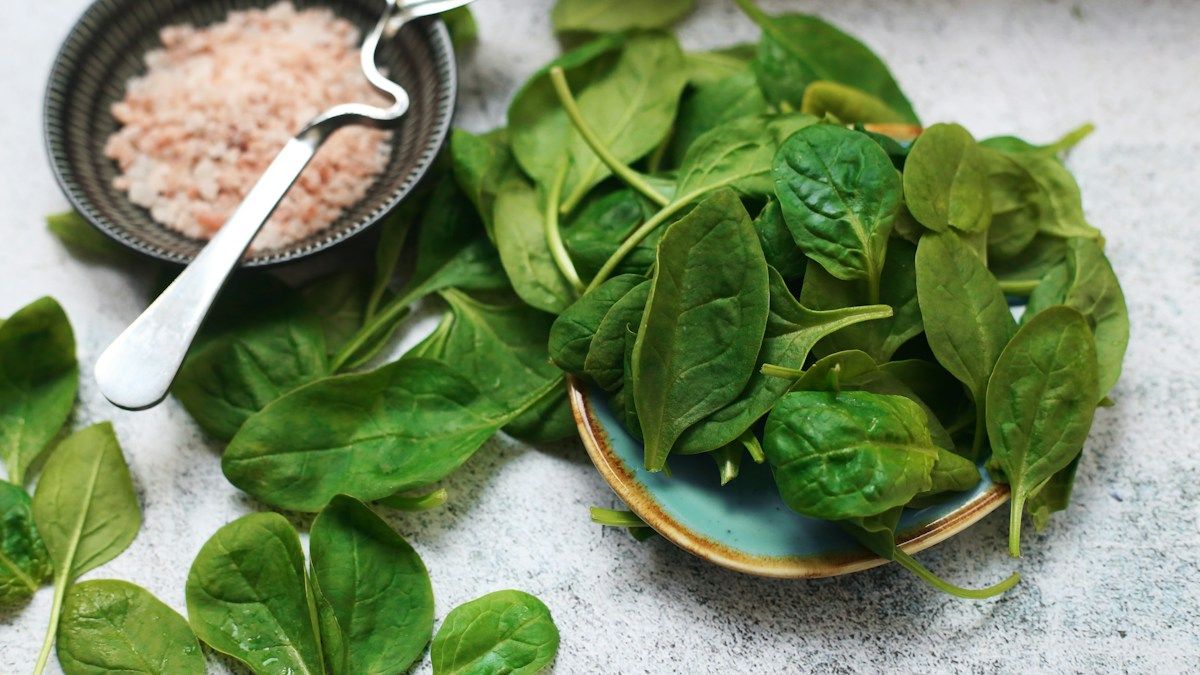
5. Leafy Greens
Spinach and other dark leafy greens with magnesium can help balance hormones beyond estrogen, such as cortisol and insulin, indirectly by supporting sleep. In one large-scale study, researchers looked for a link between magnesium and sleep and found that people with higher levels had higher-quality sleep than those with lower levels.
The study followed almost 4,000 patients over 20 years. It’s important to note that participants with the highest levels got magnesium both through food and supplementation, with specific levels that showed the correlation with the best sleep being at roughly 195.8mg/1000 calories they ate each day.
This matters for hormonal balance because sleep and hormones work together. Poor-quality sleep directly affects the body’s circadian rhythm, which plays a role in metabolic regulation, including hormones such as cortisol, leptin, and ghrelin (hunger and satiety hormones), as well as insulin sensitivity.

How to work these foods in
If you don’t eat any of these foods, telling you to just add it to your plate every day isn’t going to be very effective. New lifestyle habits take time to develop, so the best way to incorporate these foods into your already existing diet is to see what they fit in with.
For example, if you start your day with a smoothie or oatmeal every day of the week, adding flaxseeds is a great way to incorporate them without doing any heavy lifting, learning new recipes, or figuring out what they taste good with.
Fatty fish is a little harder, and it’s not going to be a daily occurrence on your plate. Pick one or two days per week to center one meal, whether it be lunch or dinner, around the one you like the most or the one that’s most convenient.
That way, it won’t feel like you’re giving up things you love to replace them with fish because that will get old fast and be much harder to adhere to.
Soy foods, leafy greens, and cruciferous vegetables can follow the same pattern. Add them to your existing diet plan twice a week to get started. It’s about adding, not taking away, by keeping them on your regular grocery list without putting too much pressure on yourself to eat a certain amount every day.

What to be careful with
Eating certain foods to support hormonal health is great, but you will need to pay attention to a few things. For example, if you already have high estrogen, eating too many flaxseeds or whole soy foods can make matters worse because they act as estrogens in the body.
On the other hand, if your estrogen is too low and you’re already on HRT, they may take things too far in the other direction since your depleted stores are already being dealt with medically.
Soy foods, specifically, should be added with caution for people who take thyroid medications because they can block the body’s ability to absorb it, specifically levothyroxine.
When food isn’t the answer
As mentioned above, food can be helpful in keeping your hormones balanced, but it’s not a magic potion, and it is not a replacement for medical care. It’s important to speak with your healthcare provider to determine whether a diet change is all you need or if you need medical intervention.

Angelica Bottaro is a medical writer and researcher with a background in psychology and journalism. She holds a bachelor’s degree in Psychology from Trent University and an Advanced Diploma in Journalism from Centennial College. Angelica has been a freelance writer since 2014, with bylines in Healthing.ca, CTV Shopping Trends, and Verywell Health, among others.
Is your neighborhood healthy?
Get a free report on your tap water, air quality, walkability and more


