Which vegetables give you the most bang for the buck? It’s a question we get a lot. Because, while vegetables can be as tasty as (almost) anything you eat, sometimes you just want to maximize the healthiness of whatever it is you’re eating. And some vegetables (like iceberg lettuce) only offer minimal nutrients. The truth is, iceberg gives you some some water, a little fiber and that’s about it. So if you’re going to order a salad, why not make it count and blast y ourself with as many vitamins, minerals and nutrients as possible?
Almost every “healthiest vegetables” list is really a popularity contest. Kale gets crowned, spinach takes second, and the ranking is mostly vibes. So we threw the vibes out and used the one time researchers actually put a number on it: a 2014 study published in the CDC’s peer-reviewed journal Preventing Chronic Disease, which scored vegetables by nutrient density:the average percentage of your daily needs for 17 different nutrients delivered per 100 calories.

How We Ranked Them
The scores come from Dr. Jennifer Di Noia’s study “Defining Powerhouse Fruits and Vegetables,” published in Preventing Chronic Disease in June 2014, using nutrient values from the USDA National Nutrient Database for Standard Reference, Release 26. Each food was scored on how much of 17 key nutrients:potassium, fiber, protein, calcium, iron, thiamin, riboflavin, niacin, folate, zinc, and vitamins A, B6, B12, C, D, E, and K:it delivers per 100 calories. A score of 100 was the maximum; anything 10 or above qualified as a nutritional “powerhouse.”
20. Pumpkin — Score: 33.82

Rounding out the top 20, the only true squash to make the cut. That deep orange flesh signals heavy beta-carotene, which your body converts to vitamin A, plus potassium and fiber. And it’s not just for pie:roasted or pureed into soup, pumpkin is a savory vegetable that happens to be sweet.
“Pumpkin is rich in vitamin A, which is really great for your vision and strengthening your immune system.”
— Julia Zumpano, RD, LD (Cleveland Clinic)
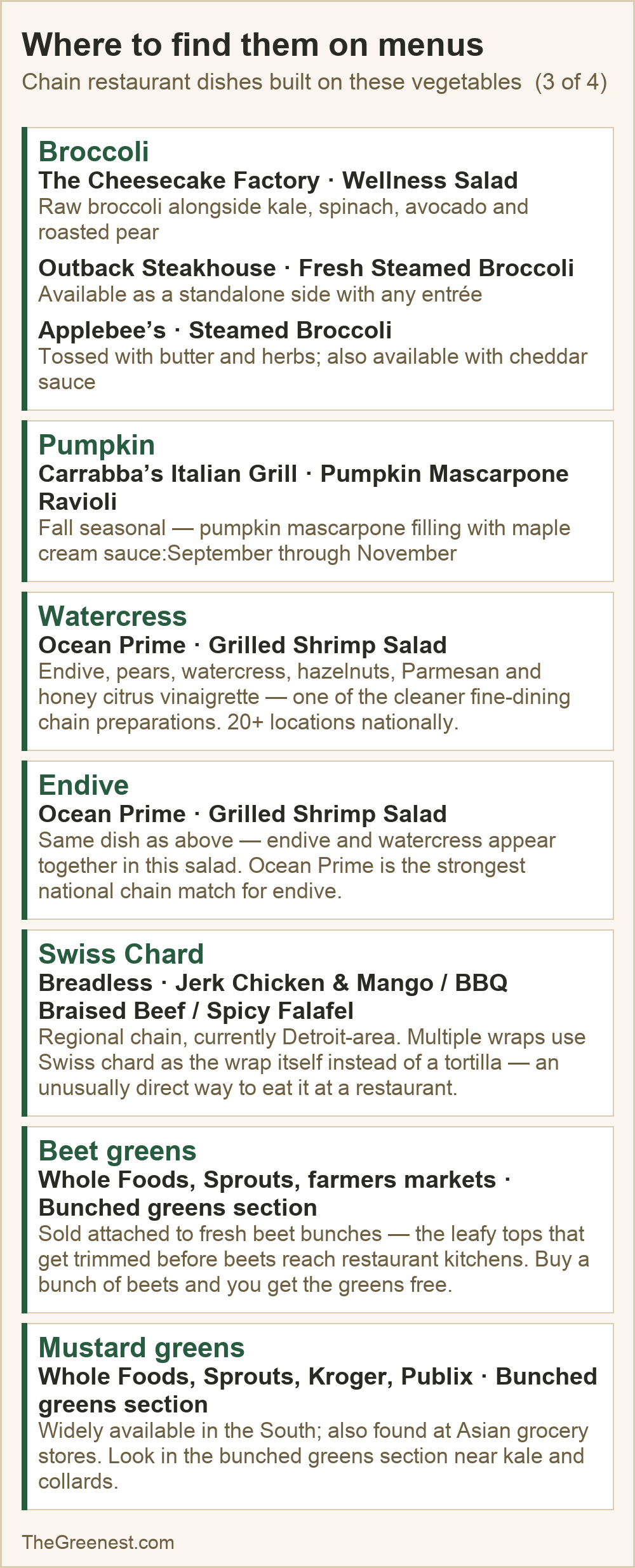
Carrabba’s Italian Grill: Pumpkin Mascarpone Ravioli (fall seasonal, September–November)
19. Broccoli — Score: 34.89

The most popular vegetable on this list for good reason: broccoli is rich in vitamin C, vitamin K, and folate, and it’s a leading source of sulforaphane, a compound studied for its cell-protective effects. Steaming or a quick sauté preserves more of its vitamin C than boiling.
“It’s packed with important nutrients like vitamin C, vitamin K, and folate, and it has about 2 grams of fiber per cup.”
— Steph Grasso, MS, RD (Author, Crave, Cook, Nourish)
Outback Steakhouse: Fresh Steamed Broccoli · The Cheesecake Factory: Wellness Salad · Applebee’s: Steamed Broccoli
18. Arugula — Score: 37.65

This peppery salad green delivers vitamin K, vitamin A, and calcium, plus naturally occurring dietary nitrates that research links to healthy blood pressure. It wilts instantly, so pile it on warm pizza or pasta right before serving.
“Arugula is packed with vitamins, minerals and phytonutrients that help prevent diseases like cancer.”
— Julia Zumpano, RD, LD (Cleveland Clinic)
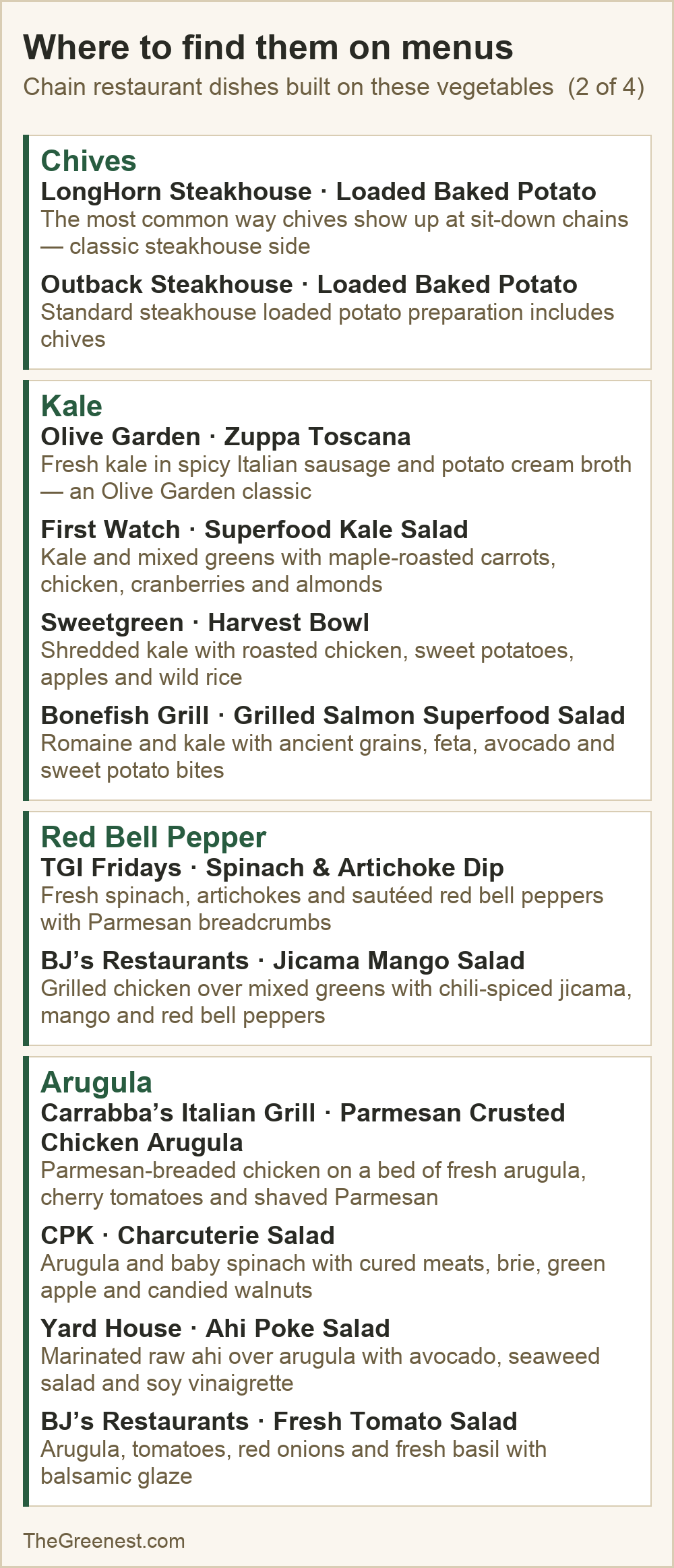
Carrabba’s Italian Grill: Parmesan Crusted Chicken Arugula · CPK: Charcuterie Salad · Yard House: Ahi Poke Salad
17. Red Bell Pepper — Score: 41.26

It has more vitamin C than an orange. The top non-leafy vegetable on the list, red bell pepper is a vitamin C and vitamin A standout, and it’s sweet enough to eat raw by the slice. Red peppers are simply riper green ones, which is why they’re sweeter and more nutrient-dense.
“While a medium orange provides about 70 mg of vitamin C, a similar-sized red bell pepper contains 150 to 190 mg.”
— Kristen Lorenz, RD (Founder, Kristen Lorenz Nutrition)
TGI Fridays: Spinach & Artichoke Dip · BJ’s Restaurants: Jicama Mango Salad
16. Dandelion Greens — Score: 46.34

The “weed” in your yard is a legitimate green, packing vitamin K, vitamin A, and calcium. Younger leaves are less bitter; older ones are best cooked. Buy them at the store rather than foraging from treated lawns.
“They’re probably the most nutritionally dense green you can eat:outstripping even kale or spinach.”
— Nancy Geib, RD, LDN (Cleveland Clinic)
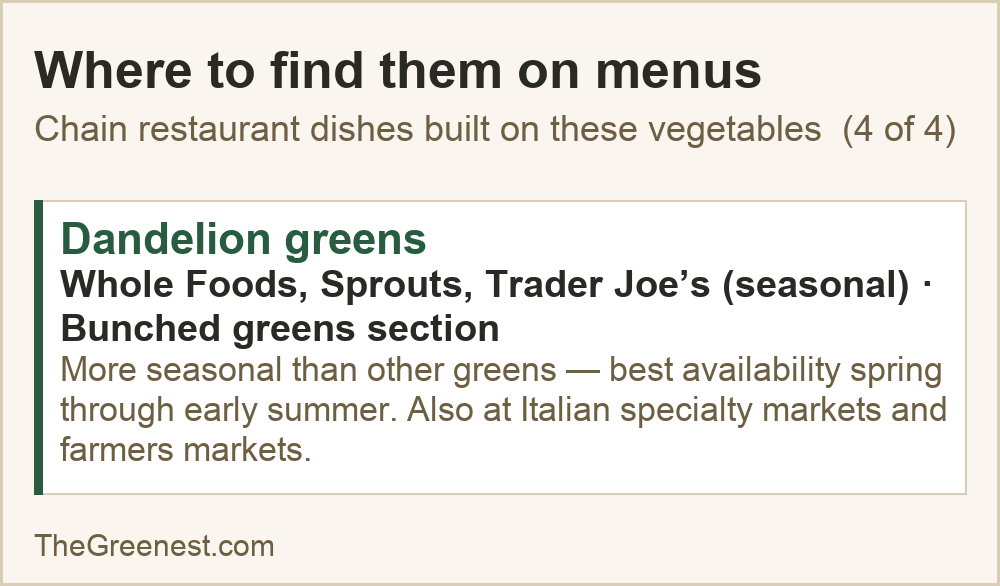
Find it at: Whole Foods, Sprouts, or Trader Joe’s (seasonal) — best availability spring through early summer. Also at Italian specialty markets and farmers markets. Buy them; don’t forage from treated lawns.
15. Kale — Score: 49.07

The internet’s favorite superfood lands at number 15. To be clear, kale is genuinely excellent:rich in vitamins K, A, and C:it just isn’t the king it was marketed as. Massaging raw kale with a little oil and salt breaks it down and makes it far more pleasant to eat in salads.
“Leafy greens like kale are full of antioxidants.”
— Stephanie Mitchell Urich, MS, RDN, LD (Missouri State University School of Health Sciences)
Olive Garden: Zuppa Toscana · First Watch: Superfood Kale Salad · Sweetgreen: Harvest Bowl · Bonefish Grill: Grilled Salmon Superfood Salad
14. Chives — Score: 54.80

The highest-ranking allium (an allium is the onion family) on the list. In addition to their lovely oniony flavor, chives carry vitamins K, A, and C. A small amount goes a long way, so snip them generously over eggs, potatoes, and soups. If you’ve ever watched a Jacques Pepin cooking video, you’ve seen him put chives in almost everything.
LongHorn Steakhouse or Outback Steakhouse: Loaded Baked Potato
13. Endive — Score: 60.44

These are the pale, spear-shaped leaves you see on appetizer trays are quietly nutrient-dense, offering vitamin K, vitamin A, and folate. While their sister veggie chicory is pretty bitter, endive is slightly lighter in terms of bitterness. And as a plus, those scoop-shaped leaves double as edible cups for dips and salads.
“Endive is a fantastic addition to any diet, as it is not only low in calories but also packed with essential vitamins and minerals.”
— Sharon Palmer, RD (The Plant Powered Dietitian)
Ocean Prime: Grilled Shrimp Salad with watercress, pears, hazelnuts and Parmesan (the strongest national chain match for endive; 20+ locations)
12. Mustard Greens — Score: 61.39

These bring a horseradish-like bite along with abundant vitamins K, A, and C. The peppery kick mellows with cooking, so sauté them if raw is too sharp for you. This is why they are typically stewed with a little diced meats (typically bacon or lardons) for long periods of time.
“Mustard leaves have great micronutrient profiles and contain vitamin C, vitamin A, copper, calcium, and vitamin K.”
— Courtney Pelitera, MS, RD, CNSC (Top Nutrition Coaching)
Find it at: Whole Foods, Sprouts, Kroger, or Publix — bunched greens section near kale and collards. Easier to find in Southern and Midwestern stores.
11. Turnip Greens — Score: 62.12

Another “eat the tops” winner. Turnip greens rival collards for vitamin K and add vitamin A, vitamin C, folate, and calcium. They’re slightly bitter, which a splash of vinegar at the end tames nicely.
“They’re packed with vitamins A, C, and K, in addition to calcium and antioxidants.”
— Isabel Balady, RDN, CDN (Northwell’s Lenox Hill Hospital)
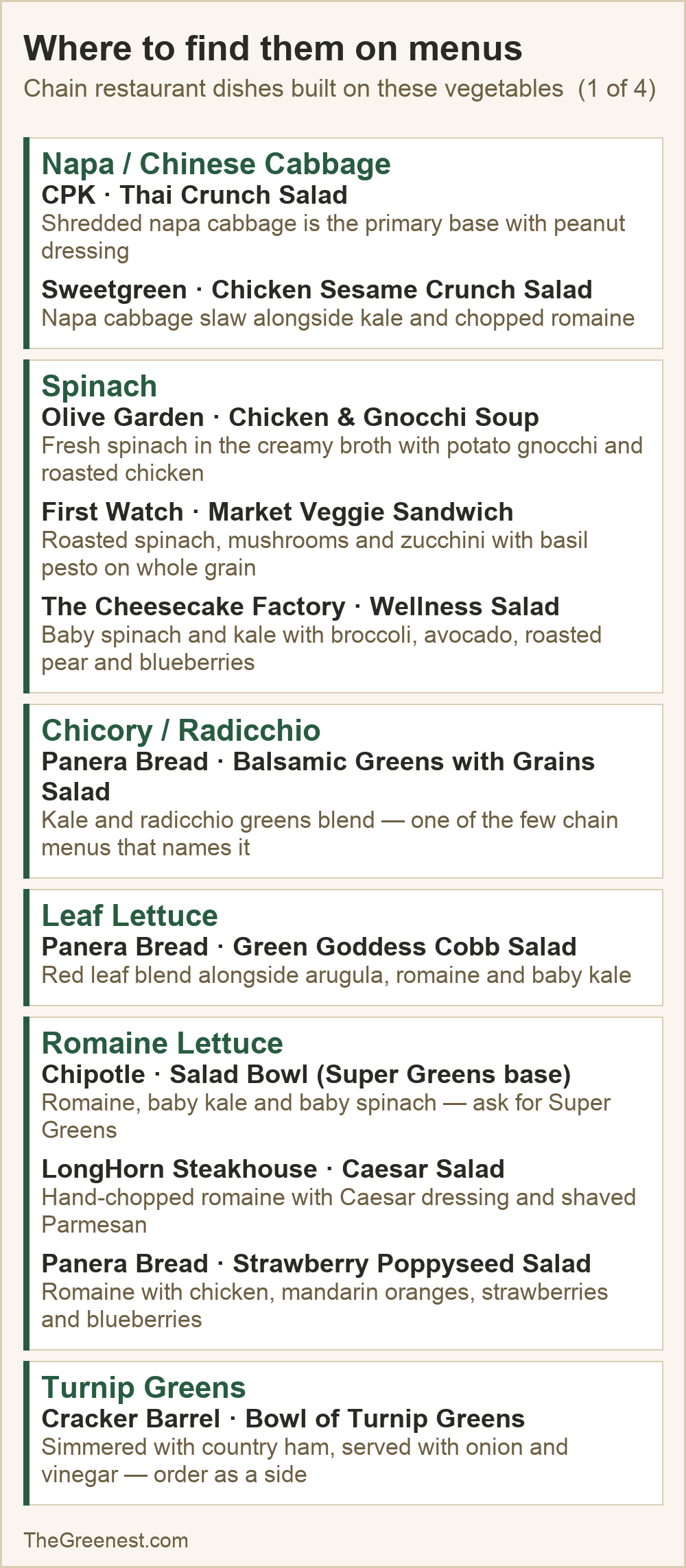
Cracker Barrel: Bowl of Turnip Greens, served as a side with onion and vinegar
10. Collard Greens — Score: 62.49

A Southern classic with serious numbers: collards are loaded with vitamin K and bring strong vitamin A, vitamin C, and calcium. Their broad, sturdy leaves also make a great low-carb wrap when used raw or lightly steamed.
“Vitamin K is key for maintaining calcium balance, making it crucial for healthy bones. Low vitamin K levels are linked with a higher risk for osteoporosis and fractures.”
— Marissa Karp, MS, RD, CDN (Founder, MPM Nutrition)
Jim ‘N Nick’s Bar-B-Q: Collard Greens side dish (48 locations, Southern regional chain)
9. Romaine Lettuce — Score: 63.48

The Caesar-salad staple is a quiet overachiever, supplying vitamin K, vitamin A, and folate while staying crisp and sweet. It’s sturdy enough to grill, which deepens the flavor without costing much nutrition.
“People often underestimate the nutritional value of lettuce. But as a leafy green, it’s just as good for you as kale or spinach.”
— Susan Campbell, RD, LD (Cleveland Clinic)
Chipotle: Super Greens Salad Bowl · LongHorn Steakhouse: Caesar Salad · Panera Bread: Strawberry Poppyseed Salad
8. Parsley — Score: 65.59

We treat it as a garnish; the data treats it as a powerhouse. Parsley is one of the most concentrated sources of vitamin K on the entire list and adds vitamins C and A. Stop pushing it to the side of the plate:chop it into tabbouleh, dressings, and grain bowls by the handful.
“Unlike other leafy greens and legumes that are rich in iron, parsley is low in compounds like phytates and oxalates that can reduce iron absorption.”
— Marjorie Nolan Cohn, MS, RD (Clinical Director, Berry Street)
Find it at: Whole Foods, Sprouts, or most grocery stores — fresh bunches in the herb section. Widely used as a garnish at chain restaurants but rarely a primary ingredient in a named dish.
7. Leaf Lettuce — Score: 70.73

Not all lettuce is just crunchy water. Loose-leaf varieties (green and red leaf) score far higher than iceberg, thanks to real vitamin K and vitamin A. The darker and more colorful the leaf, the more it’s carrying.
“People often underestimate the nutritional value of lettuce. But as a leafy green, it’s just as good for you as kale or spinach.”
— Susan Campbell, RD, LD (Cleveland Clinic)
Panera Bread: Green Goddess Cobb Salad (red leaf blend alongside arugula and baby kale)
6. Chicory — Score: 73.36

This slightly bitter green (think curly endive and its relatives) brings vitamins K and A and folate, plus inulin, a prebiotic fiber that feeds gut bacteria. Mix it into salads to balance milder leaves.
“Because it is dietary fiber, inulin can stimulate bowel movements. Fiber helps keep us full and stabilizes our blood sugars.”
— Kendra Weekley, RD (Cleveland Clinic)
Panera Bread: Balsamic Greens with Grains Salad (one of the few chain menus that names radicchio and chicory explicitly)
5. Spinach — Score: 86.43

The most famous green on the list still earns its reputation. Spinach delivers heavy doses of vitamin K, vitamin A, and folate, along with iron and magnesium. It cooks down dramatically, so a giant raw handful becomes a manageable few bites:an easy way to bank nutrients fast.
“Spinach is one of the most nutritious foods you can eat.”
— Kayla Kopp, RD, LD (Cleveland Clinic)
Olive Garden: Chicken & Gnocchi Soup · First Watch: Market Veggie Sandwich · The Cheesecake Factory: Wellness Salad
4. Beet Greens — Score: 87.08

The part most people throw in the trash outranks the beet itself. The leafy tops attached to fresh beets are exceptionally high in vitamins K and A and supply solid potassium and magnesium. Next time you buy beets with the greens on, cook both:the tops wilt down just like chard.
“Beets:and beet greens:are a good source of potassium.”
— Sarah Thomsen Ferreira, RD (Cleveland Clinic)
Find it at: Whole Foods, Sprouts, or a farmers market. Sold attached to fresh beet bunches in the produce section — buy a bunch of beets and you get the greens free.
3. Swiss Chard — Score: 89.27

Those neon stems aren’t just for show. Chard is a standout source of vitamin K and a strong source of vitamins A and C, magnesium, and potassium. Sauté the leaves like spinach and give the stems a minute’s head start so they soften.
“Swiss chard is packed with vitamins, minerals and phytonutrients.”
— Natalie Crtalic-Lowther, RD, LD (Cleveland Clinic)
Breadless: Jerk Chicken & Mango, BBQ Braised Beef, and other chard-wrapped dishes (regional chain, Detroit-area)
2. Chinese Cabbage — Score: 91.99

Bok choy and napa cabbage land just behind watercress. They’re rich in vitamins C, K, and A plus folate, and a couple of cups cost you almost nothing calorically. The mild flavor makes this one of the easiest top-five vegetables to actually eat in volume. It’s great when it’s stir-fried, in soup, or raw in slaw.
“All cruciferous veggies, including bok choy, contain molecules that appear to help your body ward off cancer.”
— Julia Zumpano, RD, LD (Cleveland Clinic)
CPK: Thai Crunch Salad · Sweetgreen: Chicken Sesame Crunch Salad
1. Watercress — Score: 100

The only food in the entire study to earn a perfect 100. This peppery little green outscored every kale, spinach, and lettuce on the board. Gram for gram it’s loaded with vitamins K, A, and C, and it’s almost all water and fiber, which is exactly why it tops a per-calorie ranking. Use it like a salad green or wilt it into soup at the last second.
“This aqueous veggie has an impressive amount of vitamin K, which is a nutrient that helps the body clot blood.”
— Lauren Manaker, MS, RDN (via Eat This, Not That)
Ocean Prime: Grilled Shrimp Salad with endive, pears, hazelnuts and Parmesan (20+ locations nationally)
Where to Find These (Restaurants and Grocery Stores)
Most of these vegetables are hiding in plain sight on chain menus:you just have to know which dish to order. The three at the bottom of this table don’t appear at any national restaurant chain, but they’re available at most well-stocked grocery stores.
The Full Ranking at a Glance
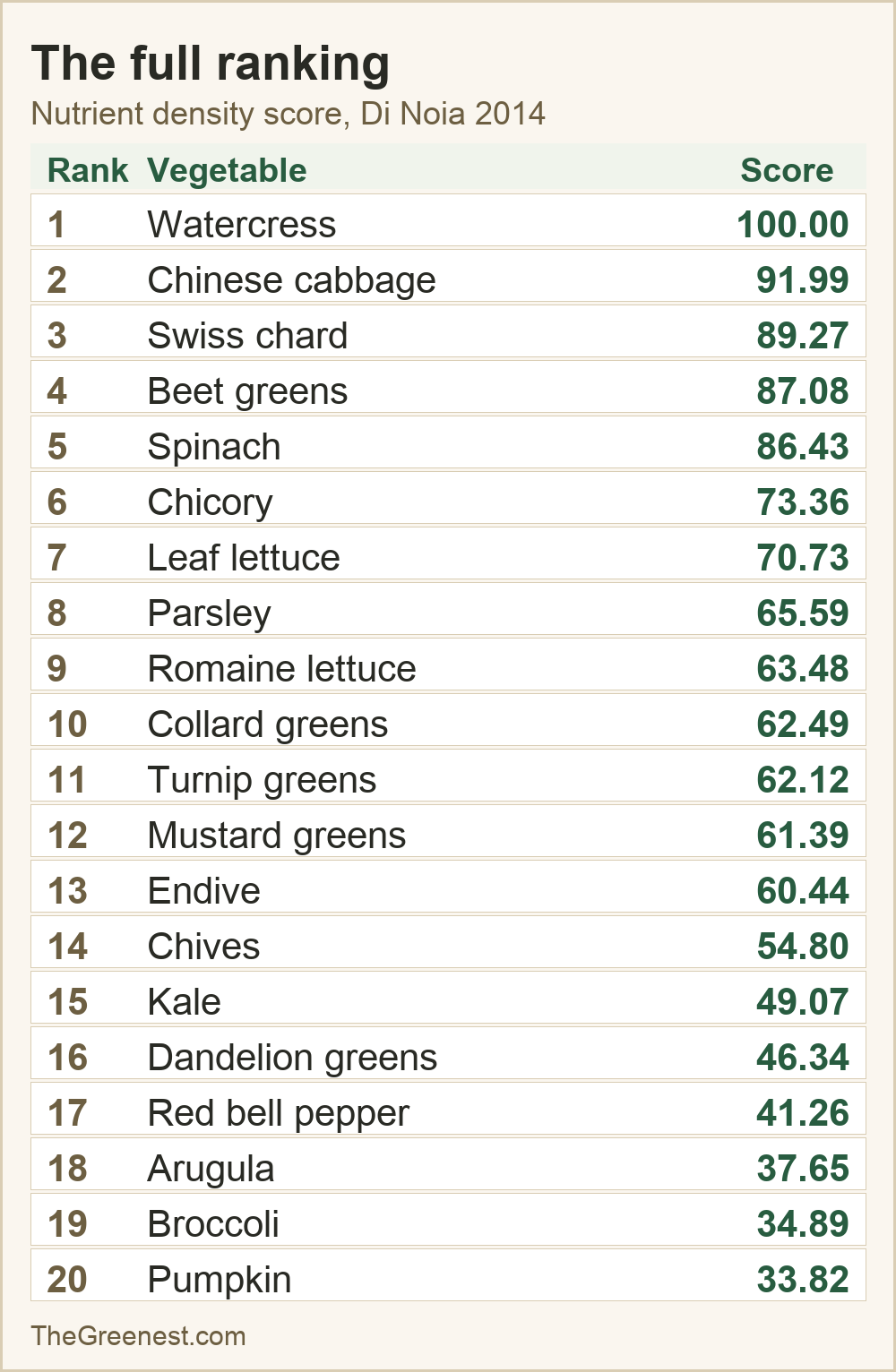
Source: Di Noia J. “Defining Powerhouse Fruits and Vegetables: A Nutrient Density Approach.” Preventing Chronic Disease, CDC, 2014.
Want to grow some of these yourself? Here’s how to regrow vegetables from kitchen scraps.

Cory Jones has spent 20 years in media and publishing and now leads the data and editorial operation behind The Greenest. He built and maintains the site’s Neighborhood Wellness Score — a proprietary dataset scoring food access, walkability, air quality, healthcare access, and health outcomes across 18,356 U.S. ZIP codes, drawing on CDC PLACES data, EPA air quality readings, and verified location intelligence. He turned 50 last year, is a huge fan of Rancho Gordo beans, and tries to work out more than he actually works out.
Is your neighborhood healthy?
Get a free report on your tap water, air quality, walkability and more