

Leafy greens have always been widely respected as a nutrient-rich food source. They’re jam-packed with a bevy of vitamins, minerals and fiber. And have been to significantly reduce the risk of high blood pressure and cholesterol, obesity, heart disease and even cancer. So can these helpful veggies also give you a great green skin care routine?
In recent years greens have gotten a reputation for more than the benefits they offer our internal organs. As well as also our largest external organ: our skin. “Green veggies are high in vitamin A, C, E and antioxidants, and are scientifically proven to aid in clearing up skin blunders such as rosacea, acne and even, eczema,” says Parneet Kaur, celebrity professional makeup (PMU) artist and founder and CEO of NeeziieBabiieBeauty.
“Green skincare embodies the idea of cleaning your skin from the inside out and getting to the right of the problem and has gained a ton of popularity in the last decade as consumers become more savvy and informed about what they are putting in their bodies.”
As it turns out, green skin care is nothing new, even though it’s having a serious moment right now.
Lynn Anderson, N.D., naturopath and yoga therapist, points out that green skin care has been around since early civilizations. “Egyptians were famous for their ‘green’ skin care products made of aloe, frankincense, myrrh and rose, as well as other herbs and plants.” And, as we’ve now come to realize, they were certainly onto something.
Perhaps the best part of green skin care is the fact that you can go green all the way. In other words, you can go green on your entire regimen—cleanser, toner, serum, moisturizer, mask, you name it. “A great green toner that has green tea extract will hydrate and give the skin the nutrients it needs,” says Habi Girmay, esthetician and founder of Shikorina By Habi.
“When it comes to face wash, a great plant-based facial cleanser will clean your skin without stripping it of its natural oils.”
If you’re looking to hop on the green beauty bandwagon, but aren’t sure where to start, we got you covered. We reached out to skin pros to find out which green ingredients are worth including in your skincare regimen.
Also Read: Is Athletic Greens really worth $100?
Green Skin Care Guide: Kale

This leafy green has become super trendy in green skin care over the last decade. Mainly for its plethora of health benefits for the body. It’s nutrient-dense, containing antioxidants, vitamins C and K, iron, calcium. Research published in the journal Food Chemistry has shown that it can reduce the risk of heart disease, among other illnesses. It’s also an excellent addition to your skincare routine.
“When this group of vitamins are infused into your skincare products, they help your skin look younger and healthier, especially vitamin C, which is an antioxidant that brightens your skin’s appearance, reduces dark circles, promotes collagen production, increases cell turnover, prevents free-radical damage, and detoxifies the skin,” says Kaur.
- Gives your body what it needs to build collagen. The body can’t make collagen without vitamin C, and 100 g of raw kale carries 93.4 mg — more than a woman’s 75 mg for the day.
- Helps your cells hold up against free radicals, the kind cigarette smoke, air pollution and sunlight produce. That antioxidant work is vitamin C’s other documented job.
- Does more for your bones than your face. Kale leads the six on calcium at 254 mg, and calcium’s job is the structure of bone and teeth.
Shop: Youth to the People Kale + Green Tea Spinach Vitamins Superfood Cleanser
Broccoli

Most of us tend to associate fruit, namely oranges, with vitamin C. But green veggies like broccoli also contain their fair share. And vitamin C has a bevy of skin benefits. Including promoting collagen, reducing the appearance of fine lines and wrinkles and protecting the skin from the sun’s harmful UV rays. “Products with natural ingredients like broccoli seed oil are easier on the skin and are anti-inflammatory (meaning they don’t cause dryness or irritation),” says Kaur. “Broccoli seed oil is rich in fatty acids, so it’s great to use in skincare products like serums which work best with a thicker consistency.”
- Feeds the same collagen step kale does — 91.3 mg vitamin C against kale’s 93.4, a gap you would never notice on a plate.
- Helps your cells divide and copy their DNA. That is folate’s job, and broccoli has 65 mcg of the 400 mcg an adult needs each day.
- Won’t be your vitamin E source. At 0.1 mg per 100 g it is the lowest of the six, against a 15 mg daily target.
Shop: Elemis Superfood Facial Oil
Avocados

This creamy, green fruit (yes, fruit!) is loaded with good-for-you fats that contain a slew of green skin care benefits. They are an excellent source of vitamins E and C. Which prevent inflammation and treat inflammatory skin conditions such as acne. But avocados also play a pivotal role in keeping skin plump and firm with collagen and elastin. “That’s a key to anti-aging,” says Kaur. “Vitamin E also aids in tissue repair, which can be beneficial through the years to help fight aging.”
- Protects cells from free-radical damage. That is what vitamin E does, and avocado has 2.1 mg — roughly a seventh of a day, second only to dandelion greens here.
- Backs up cell division with 81 mcg folate, more than kale or broccoli manage.
- Skip it if you came for vitamin C or K. 10 mg vitamin C, and 21 mcg vitamin K — the lowest K reading of the six.
Shop: Origins Drink Up Nourishing Avocado Lip Butter
Dandelion greens

One of Girmay’s go-to leafy greens for total skin nourishment is dandelion greens! Rich in calcium, iron and vitamins A, C, K and B2, they have a ton of benefits for nearly all of your bodily organs. And that includes your skin. In fact, dandelion greens are an exceptional natural treatment for acne. Something an estimated 10 percent of the population suffer from, per a report in the British Journal of Dermatology. “Dandelion greens have detoxifying properties that rid the skin of toxins that clog pores and cause acne, as well as vitamin C to speed up the body’s natural healing process and reduce the appearance of scars and skin inflammation,” says Girmay.
- The strongest antioxidant showing of the six. 3.4 mg vitamin E per 100 g, ahead of avocado, spinach and kale, doing the free-radical work vitamin E is known for.
- Most vitamin A here by a wide margin — 508 mcg RAE, about three-quarters of a woman’s day, which NIH ties to vision, immune function, and growth.
- Most iron of the six at 3.1 mg, the mineral your body uses to build hemoglobin and move oxygen out of your lungs.
Shop: Dandelion Detox Solid Facial Cleanser for Clarified Skin
Spinach

Spinach is another one of Girmay’s favorite green skin care ingredients. “It contains vitamins like kale and dandelion, but it also is packed with B vitamins, another staple vitamin for the skin,” she says. “Another benefit of spinach is that it promotes radiant skin, but also helps the skin heal from sun damage and fortify the skin barrier.” The best thing about spinach? You don’t need to purchase a skincare product that contains it to reap its benefits. Have a little left over from making juice from your juicer? Girmay recommends simply getting a cotton pad and using the green juice as a toner.
“If you can find some of these in powder form you can also make a homemade mask with the powder and juice from these greens,” she says. If you do go the DIY route, just be sure not to leave the juice in the fridge for too long since the vitamins will die off after 48 hours.
- Most folate of the six — 194 mcg, close to half an adult’s day, for making DNA and dividing cells.
- Second-highest vitamin A at 469 mcg RAE, behind only dandelion greens.
- Matches avocado on vitamin E, 2.0 mg against 2.1, for the same antioxidant job.
Shop: 3Lab Super “H” Serum
Kelp

Growing up on an island off the coast of Maine, Dr. Anderson became quite familiar with kelp—the brown algae seaweed that makes for an excellent skincare ingredient. “We used it in traditional folk medicine as a poultice or application for inflamed skin and for minor cuts and lesions,” she says. “It is rich in antioxidants and has anti-inflammatory properties which are needed to heal skin and to keep it healthy.” If you’re looking to DIY a kelp-infused skincare product, she recommends simply mixing dried kelp with any carrier and then applying it to the skin as a mask to cleanse, hydrate and renew skin.
- Not a vitamin C green at all. 3 mg per 100 g against kale’s 93.4. If collagen support is why you are eating greens, this is the wrong one.
- A real source of iron at 2.9 mg, second only to dandelion greens — the mineral behind hemoglobin and oxygen transport.
- Second-most folate at 180 mcg, behind spinach, for cell division and DNA.
SHOP: The Seaweed Bath Co. Restoring Marine Algae Overnight Mask
| Per 100 g, raw | Vitamin C | Vitamin A | Vitamin E |
|---|---|---|---|
| Kale | 93.4 mg | 241 mcg | 0.7 mg |
| Broccoli | 91.3 mg | 8 mcg | 0.1 mg |
| Dandelion greens | 35 mg | 508 mcg | 3.4 mg |
| Spinach | 28.1 mg | 469 mcg | 2 mg |
| Avocado | 10 mg | 7 mcg | 2.1 mg |
| Kelp | 3 mg | 6 mcg | 0.9 mg |
Eating Your Greens and Applying Them Are Different Things
The National Institutes of Health says vitamin C is necessary for the biosynthesis of collagen. Collagen is part of your body’s connective tissue and may play a role in wound healing. All of that is true.
Does any of it matter? Not unless you’re going to eat the ingredient. Broccoli contains vitamin C. That doesn’t tell you how much of the vitamin is contained in a bottle of facial cleanser, or whether your body can use it. It also doesn’t tell you what a facial cleanser does while it’s on your skin or what it does once you wash it off your face.
Keep in mind, however, that grocery shopping and skincare shopping are two very different experiences. With vegetables, your best asset is your sense of taste. After all, you’re not likely to eat foods on a regular basis that you don’t enjoy. With skincare, your best asset is the ability to look at products as a whole, what’s in them, what they claim to do, and how your skin reacts when you use them.
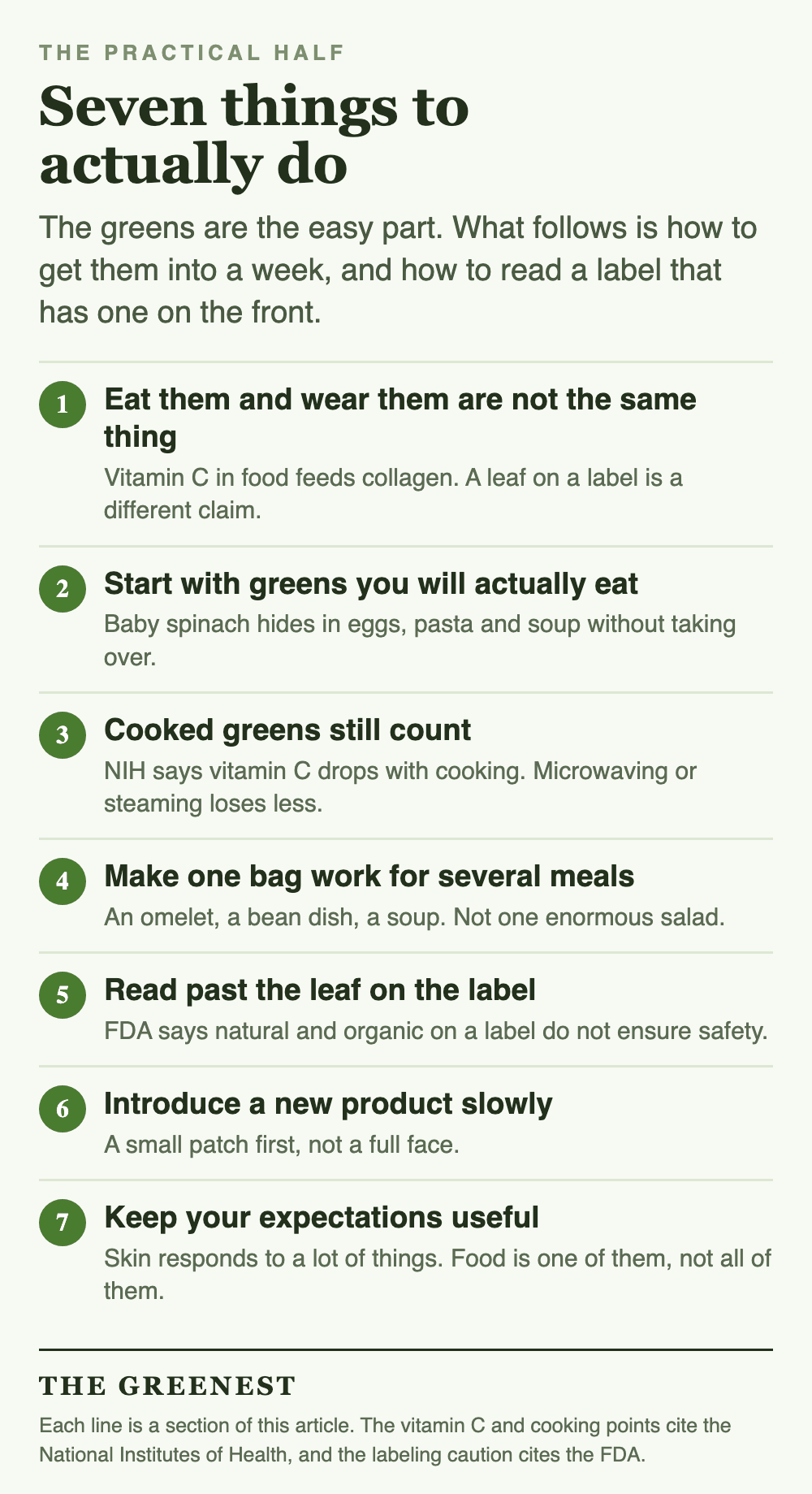
Start With Greens You’ll Actually Eat
You can sneak baby spinach into scrambled eggs, stir-fried pasta or a pot of soup without it totally overtaking the dish. Romaine lends a nice crunch to sandwiches. Arugula is delicious over a hot pizza or roasted alongside veggies. Tougher greens can be chopped up finely, cooked to your preferred level of tender and added to meals.
Darker greens supply carotenoids like beta-carotene, which is converted to vitamin A when it’s consumed. According to the National Institutes of Health, spinach, among other green veggies, is considered a source of the nutrient. There’s no single best leafy green, so grab one you’re comfortable with and a smaller portion of one you want to try out. That way you won’t have three giant, drooping bunches languishing in your refrigerator’s crisper drawer.
Cooked Greens Still Belong on the Menu
Boiling isn’t the most effective way to prepare vegetables. According to the National Institutes of Health, vitamin C levels in foods may decrease with prolonged storage and cooking. Using a microwave or steaming may lessen those cooking losses.
The problem with boiling is that many people boil vegetables for longer than they should. The argument against boiling is really an argument against overboiling. Steaming broccoli until it’s as firm as you like is perfectly fine. Quickly sauteing kale in olive oil with garlic is fine, as long as it’s tender but not mushy when you remove it from the pan. Using frozen vegetables in recipes that don’t require crunchy vegetables is fine.
Do whatever makes you want to eat them. If that means overboiling the green beans and serving them with butter and salt, so be it. You may not get all of their nutrients, but chances are, if they’re tasty, you’ll eat them again.
Make One Bag Work for Several Meals
Greens are more useful if you use them in a number of dishes. For example, instead of making a big spinach salad, use some in an omelet, some in a bean soup and some in a pasta sauce. Similarly, that bunch of kale could be a salad one night and a cooked side the next. Use different seasonings in each dish so the meals don’t taste too much alike.
The FDA recommends washing all fruits and vegetables under clean, running water just before preparing or eating them. Don’t wash produce with soap, detergent or commercial produce washes. Produce can absorb household cleaners and cause you to become sick, even after they’ve been rinsed well.
Some types of bagged and packaged fruits and vegetables have been washed already and are ready to eat.
Wash your hands with soap and warm water for at least 20 seconds before and after handling fruits and vegetables, and use clean utensils and cutting boards. Washed greens should be dried well and refrigerated right away.
Read Past the Leaf on the Skincare Label
The FDA cautions consumers to be wary of products containing ingredients that manufacturers characterize as organic or natural. Such terms don’t ensure product safety. Similarly, the American Academy of Dermatology cautions that natural or botanical formulas may still contain fragrance-related ingredients. Fragrance ingredients may be used in products labeled as unscented.
Start with what you want your product to accomplish. Then scrutinize the ingredients and directions with an eye toward its intended function, removing makeup or moisturizing for instance, and its effectiveness. Fragrance-free products may be preferred if you’re prone to fragrance-related skin irritation. Just because something’s a plant doesn’t mean it’s safe or effective. There’s nothing wrong with enjoying a product. It’s not necessary for all of the ingredients in it to have a specific purpose.
Give a New Product a Small Introduction
It’s best to add one product at a time to your routine. If you’re going to introduce a new cleanser, a new serum, and a new face mask all in one week, it’s going to be difficult to figure out what’s helping and what’s hurting. But, if you narrow it down and choose just one, you’ll be able to see how it affects your skin.
And, even still, it’s best to do a patch test before applying a new product to your entire face. The American Academy of Dermatology recommends applying the product on a quarter-sized area twice a day for 7-10 days. The best areas to apply it would be somewhere that’s relatively undisturbed, like the underside of your arm, or in the bend of your elbow. Make sure to read the directions to see if you’re supposed to wash it off or not. Stop using it immediately if you have a negative reaction.
Just because that vegetable juice in the back of your kitchen is leftover doesn’t make it safe to put on your face. It may seem like patch-testing it would tell you if your skin has a reaction to it, but you’ll have no idea if it has any harmful microorganisms.
The FDA requires that cosmetics are free of harmful microorganisms. Sterility isn’t a requirement, but cosmetics do have to meet microbial limits for aerobic microorganisms per gram. Especially if you’re starting out in skincare, avoid kitchen concoctions and go for products that are formulated to be used on the face.
Keep Your Expectations Useful
Leafy greens are good for your body. But don’t expect specific results like faded spots, fewer wrinkles, and clearer skin in a certain amount of time.
The American Academy of Dermatology notes that diet may play a role in causing or worsening acne. However, there’s more to keeping skin clear than dietary changes. There are skincare products and medication that are friendly to acne and help prevent new breakouts. Going back to the grocery store isn’t going to cut it.
The American Academy of Dermatology recommends using a water-resistant sunscreen that shields from UVA and UVB rays (called broad-spectrum protection) and has an SPF of at least 30. There’s no serum that smells like a botanical garden to replace that. Choose one thing you can do, whether cooking that veggie one more time or finding a product for your skin that will meet your needs.
Green Skin Care – In Conclusion
News flash: leafy greens are good for you. The centuries of data show that the more leafy greens we eat, the healthier we will be in general. So it stands to reason that greens will help your skin — which is also your biggest organ. Some of the data is still out about green topicals. But we’re always up for promoting getting more good greens.

Jenn Sinrich is a freelance editor, writer and content strategist located in Boston, Massachusetts. She received her BA in journalism from Northeastern University and has more than a decade of experience working for a myriad of female-focused publications including SELF, Parents, Women’s Health, BRIDES, Martha Stewart Weddings and more. When she’s not putting pen to paper (or, really, fingers to keyboard), she’s enjoying the most precious moments in life with her husband and daughter.
Is your neighborhood healthy?
Get a free report on your tap water, air quality, walkability and more


