The world of supplements can be tricky. There’s a million options. And they all make claims that seem too good to be true (and many are.) But that’s not to say all supplements are just marketing schemes.
Many have actual benefits. You just need to make sure you’re choosing the right supplement from a reputable brand that actually puts in the ingredients that they claim to put in.
As you get older, your liver and kidneys become slower at removing compounds from your body, which can result in some potentially harmful buildup. At 60, fat-soluble vitamins stay in your tissues longer than they used to.
Women tend to take more prescription medications as they get older, which increases the likelihood that a supplement will interact badly with one of them. On top of that, some of the supplements that are currently on the market have never been tested on older adults. There isn’t always research behind a supplement showing whether it’s safe for people your age.
Pharmacists’ Six-Item Watchlist for Women 60+
And a quick note on pharmacists. A lot of people don’t use their pharmacist for advice as much as they could. They are right there and it’s like having access to a medical professional that is free of charge. Feel free to ask one at your local pharmacy the next time you’re there.

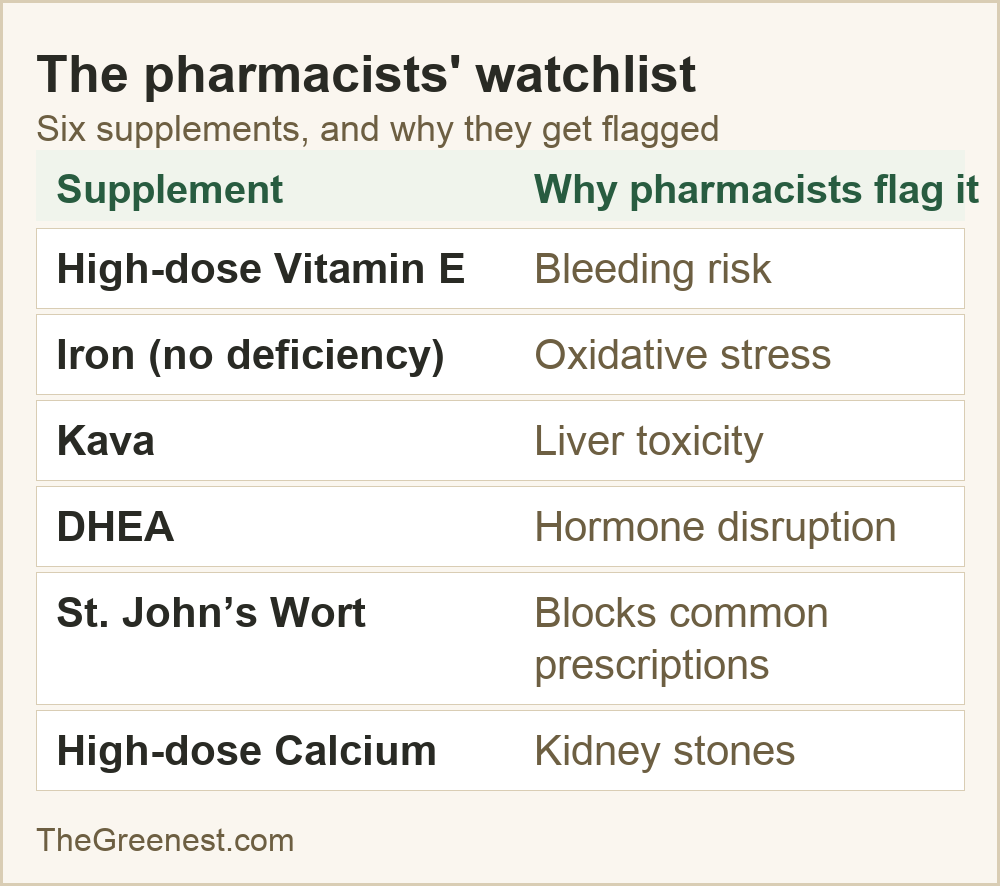
What to take instead is covered with each one below.
- If you take three or more prescription medications.
- Did you start a supplement after a TV segment, a friend’s recommendation, or based on social media?
- Your doctor doesn’t have an up-to-date list of everything you’re taking.
- You have a personal or family history of any hormone-sensitive condition.
- You’re on blood thinners, statins, antidepressants, or heart medications.
- You’ve been picking up supplements at retail without running interactions by a pharmacist.
1. High-Dose Vitamin E

Vitamin E is sold in most stores as an antioxidant and a heart-health supplement. But like any supplement, Vitamin E does have side effects. Vitamin E is considered to be quite safe at lower doses. But at higher doses of 400 IU or more, Vitamin E is a blood thinner, meaning it prevents blood from clotting as quickly. This can be especially problematic for anyone who is on a medication that’s also a blood thinner, like aspirin or warfarin or a direct oral anticoagulant. So don’t take high doses of vitamin E if you’re on blood thinners.
A 2005 meta-analysis from Johns Hopkins, published in Annals of Internal Medicine, pooled nineteen randomized trials covering more than 135,000 participants. Specifically, high-dose vitamin E supplementation was associated with a small but statistically significant increase in all-cause mortality — enough that the authors concluded such doses “should be avoided.”
Most older adults already get adequate vitamin E through diet without supplementing, which is why geriatricians tend to treat the high-dose pill aisle as low-hanging fruit in a “stop taking this” conversation. Or at least think twice before jumping in. And as always, ask your medical professional before adding any of this to your regimen.
“Just because it may be an anti-inflammatory doesn’t mean it’s the best thing for you. That is one I often counsel my patients to come off of.”
— Dr. Kathleen Hager, internal medicine geriatrician, OhioHealth (on high-dose vitamin E)
2. Iron Supplements (Without a Diagnosed Deficiency)

Let’s start out by saying one important thing: Don’t self diagnose! Iron is one of those easy things to assume. If you’re tired, then you probably are low on iron. So we find that a lot of the people who start their own iron supplement self-diagnosed themselves based on how tired they are.
But that’s not always the case at all. And having that assumption be wrong can have some significantly negative consequences. And let’s be honest, are we all a little tired most of the time.
Life is hectic! Having gotten that out of the way, iron deficiency is common in premenopausal women. After menopause, the picture flips.
Premenopausal women tend to be deficient because of monthly blood loss, so iron can be beneficial for this population. After menopause, most women are not iron-deficient, often the opposite, so women over 60 should think twice before taking unnecessary iron. The body has no good way to get rid of extra iron. So any excess gets stored in various tissues.
Long-running cohort research out of eastern Finland has linked high body-iron stores to oxidative stress and to raised cardiovascular risk. Iron overload is also a well-established driver of liver damage.
The best thing to do (as always) is to get some simple bloodwork done to see where your iron levels actually are. Supplements shouldn’t be an easy way out. And if you don’t know your bloodwork you’re flying blind.
As Dr. Victoria Maizes, MD, executive director of the Andrew Weil Center for Integrative Medicine at the University of Arizona, puts it: “Excess iron can increase the risk of heart disease, diabetes and various kinds of organ damage.” Many standard multivitamins still contain iron because they’re formulated for the broader adult population.
If you’re over 60 and don’t have a deficiency, it’s important to make sure that your multi-vitamin doesn’t contain iron. Again, always read labels.
Don’t take iron unless you know for a fact via a simple blood test that you need to. Ask your doctor to include a test to determine your ferritin level at your annual checkup. Ferritin is the most important number to pay attention to in determining if you need iron.
3. Kava

There’s one trope in the supplement world that we’d like to put an end to. And that is people typically think “natural means safe.”
That is not the case (remember, uranium is natural and you wouldn’t take an “All-Natural Uranium” supplement.) Kava is marketed for stress and anxiety relief and does have real pharmacological effects: it produces sedation and reduces anxiety in clinical trials.
But there’s also an important caveat. It has a pretty well documented risk of serious liver toxicity. In 2002, the U.S. Food and Drug Administration issued a consumer advisory after reports of liver damage — including at least one case requiring a liver transplant — were associated with kava-containing supplements.
The liver risk is not simply a matter of how much you take. Severe liver injury has been reported at moderate intakes, and kava can also interact with medications at any dose. And the problem for women over 60 is they are more likely to be on meds that metabolize through the same liver pathways that kava.
This is why kava lands on a lot of pharmacist’s “don’t” lists. If you’re looking for a sleep aid of some kind, most medical professionals would recommend a 200-400 mg dose of magnesium glycinate at bed time. It’s been studied a ton.
“Various kava products have been linked to rare cases of liver injury, some of which have been serious or even fatal.”
— National Center for Complementary and Integrative Health, National Institutes of Health
4. DHEA

Dehydroepiandrosterone (DHEA) is a hormone precursor sold over-the-counter and marketed as an anti-aging hormone for women, which may help improve mood, energy, bone density, and libido. Once taken, DHEA is converted to estrogen as well as testosterone. Because its metabolic pathways are loosely regulated, the same amount of DHEA per day might cause major hormonal changes for one woman and have little impact on another.
The problem is what happens inside the body: DHEA converts to estrogen and testosterone through pathways that aren’t tightly regulated, so the same daily dose can shift hormone levels meaningfully in some women and barely at all in others.
Which is why you really should consult a medical professional before taking a new supplement. We don’t mean to be a broken record, but while these supplements can be beneficial, they can also cause serious harm. As Rachel Pope, MD, an OB/GYN and certified menopause practitioner at University Hospitals, puts it:
“We actually don’t know if our body even metabolizes oral DHEA the way we want it to.”
— Rachel Pope, MD, OB/GYN and certified menopause practitioner, University Hospitals
For women with a personal or family history of hormone-sensitive cancers — breast, ovarian, endometrial — that unpredictability is a meaningful concern. The Mayo Clinic (you’ve probably heard of it) advises that anyone with a hormone-sensitive cancer should not use DHEA, and notes that quality control on the supplement is often poor.
If you’re on hormone therapy, your doctor has carefully adjusted that dose for your body. Using the supplement, especially over-the-counter, can interfere with prescribed hormone replacement therapy. Unfortunately, this isn’t even listed on the bottle.
Pharmacists are adamant that you not use DHEA unless it’s prescribed and being monitored by lab work by your endocrinologist or OB-GYN.
Most pharmacists welcome these and can answer them in five minutes — usually before you even pay for what you’re picking up.
- “I’m thinking about starting [supplement]. Will it interact with anything I’m currently taking?”
- “Are there any age-related reasons this isn’t a good fit for someone my age?”
- “Is the dose on this bottle the dose the research supports, or is it higher?”
- “Are there any third-party certifications I should look for on the label?”
- “How will I know whether it’s working — and how long should I give it before judging?”
5. St. John’s Wort

Ok, this one is really worth noting. St. John’s Wort is one of the most-studied herbal supplements for mild depression. We have probably known someone who has tried SJW at some point in their lives thinking it was a natural alternative to Prozac or SSRIs. But the catch?
St. John’s Wort induces a liver enzyme called CYP3A4, which means it speeds that enzyme up. This results in any medication that the same enzyme breaks down being cleared faster, reducing its level in your system. So you’re taking the dose your doctor prescribed, but the amount actually reaching your system is lower than that. For this reason, many pharmacists will not recommend St. John’s Wort to women over 60.
CYP3A4 helps metabolize a large share of prescription drugs in use today. So talk to your doctor! The National Center for Complementary and Integrative Health, part of the NIH, names St. John’s Wort as a potent inducer that interferes with drugs including blood thinners (warfarin), the heart-rhythm drug digoxin, immunosuppressants, oral contraceptives, and antidepressants; the broader pharmacology literature adds statins and some chemotherapy drugs to that list.
“Say you needed a medicine at a dose of 200 milligrams. Because you’re also on Saint-John’s-wort, you only got 100 milligrams because it was broken down faster and it got out of your system faster.”
— Dr. Victoria Maizes, MD, Andrew Weil Center for Integrative Medicine, University of Arizona
About a third of American adults aged 60 to 79 take five or more prescription drugs, according to the CDC. St. John’s Wort can interfere with a lot of them, anywhere from making a prescription less effective to causing real harm.
The fact that SJW is sold near daily multivitamins and has the word “natural” all over the labels, most folks assume is safe and probably benign.
One of those products that “can’t hurt” so you think the downside is low. But as we’ve learned here that’s not the case at all. If you want help navigating the supplement and vitamin aisle, check out our pharmacist’s guide to reading a supplement label.
6. High-Dose Calcium Supplements

Calcium is another one that most people feel “more equals better” about. We all know we lose bone density as we age, so the more calcium we take the stronger our bones will be, right? Well, not so fast. Calcium supplementation had been the default women’s-health recommendation for decades.
But recently the evidence has gotten more complicated. A 2010 meta-analysis of 15 randomized trials found calcium supplements — not dietary calcium — associated with a 27% relative increase in heart-attack risk among people taking calcium without co-administered vitamin D. The confidence interval was wide, so treat it as a signal worth knowing rather than a settled number.
More recent studies have honed the risks more carefully. Most of the cardiovascular risk concentrates around high single doses (above 500 mg at once), without vitamin D, on a baseline of already-adequate dietary calcium. Calcium is one of those minerals where you probably don’t need a supplement for a few reasons.
First, it’s available in a lot of foods. And a small diet change can really have an impact on how much calcium you’re ingesting. And second, and most importantly, we typically recommend getting your vitamins and minerals from food whenever possible.
Food intake almost always triumphs over the supplement intake. It’s more natural and the body usually processes it better. So do your best to up calcium-rich foods and you should be pretty good to go. “I tell my patients to make sure they’re getting adequate amounts of calcium from their diets,” says Dr. Rhanderson Cardoso, a cardiologist at Harvard-affiliated Brigham and Women’s Hospital. The pharmacist’s translation is the same: get calcium from food where possible; if you supplement, cap each dose at 500 mg, pair with vitamin D3 and magnesium, and don’t double up on calcium-fortified products without realizing it.
- Instead of Kava — Magnesium glycinate, 200–400 mg before bed. Well-studied for anxiety and sleep, with a clean interaction profile for most older adults.
- Instead of high-dose Vitamin E — A small handful of almonds, sunflower seeds, and avocado. A 1 oz serving of almonds delivers roughly 7 mg of vitamin E — well within safe range, no pill needed.
- Instead of iron supplements (without testing) — Ask your doctor for a ferritin blood test first. If you’re genuinely low, food sources beat pills: lean red meat, lentils, fortified cereals paired with citrus for absorption.
- Instead of St. John’s Wort — Talk to your prescriber. Evidence-based options for mild depression exist that don’t share the drug-interaction risk, and your pharmacist can help compare them.
- Instead of high-dose calcium — Dietary sources first: plain whole-milk yogurt (~300 mg/cup), sardines with bones (~325 mg/serving), cooked kale. If you supplement, cap each dose at 500 mg and pair with vitamin D3 plus K2 and magnesium.
Now would be a good time to audit your medicine cabinet (or wherever you keep your supplements.) Which ones do you have on this list? How often do you take them? And have you ever talked to a medical professional about any of them. Easy answers to some pretty important questions.
There’s no evidence that taking any of these is wise if you’re a woman over 60 taking prescription drugs. Natural does not make a supplement safe at any age. Read up on interactions between the supplements you’re considering and check with your local pharmacist.
There are companion pieces on what to take in your 60s, what to take in your 70s, and how to make 65 to 85 your healthiest years.
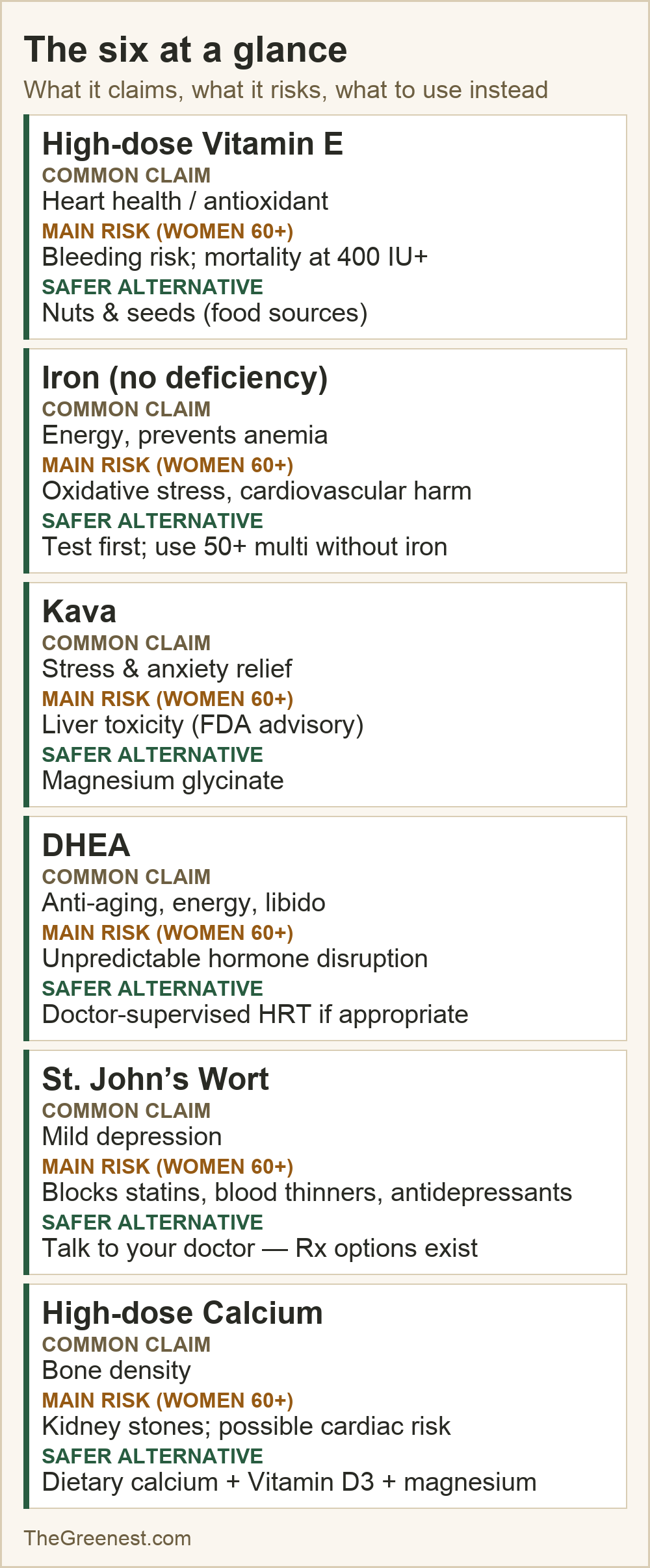
The six at a glance, with safer alternatives

Joseph has been writing and editing for a wide variety of publications over the last decade. He loves covering news in the health and wellness space and has written extensively about all aspects of wellness for a wide range of publications.
Is your neighborhood healthy?
Get a free report on your tap water, air quality, walkability and more