Once you’re past 50, preserving muscle mass is key and increasingly difficult, so protein becomes critical. And since your blood pressure likely increases with age, watching sodium is critical, as well. The American Heart Association says 2,300 mg is the maximum you should have per day, but 1,500 mg is optimal for most people. Fiber is a concern, too, with most Americans falling well short of recommended levels.
So, although calories still count, protein, sodium, and fiber deserve extra consideration at Chipotle and beyond. Here’s where Chipotle shines. At the counter, you have complete control over the makeup of your dish. That means your creation could be the perfect, healthy, and relatively light lunch, or it could include the majority of your allotted sodium for the day.
Fortunately, the chain shares nutritional information for all of its ingredients. Below, we pit ten ordering decisions against each other, so you can see how they stack up nutritionally.
Nutrition checked September 22, 2026, using Chipotle’s published U.S. nutrition information. Figures cover the portions listed, not whole meals, and standard scoop sizes vary in practice. Drinks and extra sides are excluded unless named.
1. Burrito Bowl vs. Burrito


The bowl: the tortilla alone is 320 calories and 600 mg of sodium.
Instead of ordering a burrito, order a burrito bowl. Before any filling is added, a flour tortilla contains 320 calories, 600 mg of sodium and 9 grams of fat. Ordering your meal as a bowl cuts all of those calories, sodium and fat. If you’re concerned about cutting out the 3 grams of fiber you’d get from the tortilla, add a 4 ounce scoop of black beans, which has 7 grams of fiber.
That’s an easy switch that doesn’t add any of those unwanted calories, sodium and fat. Also, if you’re missing your corn chips, three crispy corn tortillas, ordered on the side, is a 210 calorie, 0 mg of sodium alternative.
2. Chicken vs. Carnitas


Chicken: 9 more grams of protein, less than half the saturated fat.
After 50, chicken is the way to go at Chipotle. For every 4 ounces of Chipotle chicken you add to your bowl, you’re adding 180 calories and a whopping 32 grams of protein. There are 3 grams of saturated fat and 310 mg of sodium. In comparison, 4 ounces of carnitas (braised pork) adds 210 calories and only 23 grams of protein, along with 7 grams of saturated fat and 450 mg of sodium.
So not only do you get 9 more grams of protein from the chicken, but you’ll be consuming less than half of the saturated fat.
3. Steak vs. Barbacoa


A real toss-up: steak for blood pressure, barbacoa for protein.
Steak and barbacoa are closer than you may have expected nutritionally. Per 4 ounces, steak contains 150 calories, 21 grams of protein and 330 mg of sodium. Barbacoa, on the other hand, has 170 calories, 24 grams of protein and 530 mg of sodium. Both are made with beef. So what’s the healthy choice? Well, that all depends on your immediate nutritional goals.
If you’re watching your blood pressure and need to keep your sodium down, the best bet is steak. But, if you’re trying to maintain your muscles and don’t mind a little extra salt, you should spring for barbacoa. Either way, the difference in sodium content between the two options is 200 mg.
4. Beans vs. a Second Scoop of Rice


Beans: fewer calories, seven times the fiber, no upcharge.
Here’s another healthy switch that will help your body: Beans. A 4-ounce scoop of black beans has 130 calories, 7 grams of fiber and 8 grams of protein. Pinto beans are similar, having 130 calories, 8 grams of fiber and 8 grams of protein. By comparison, the same size serving of cilantro-lime white rice has 210 calories but only 1 gram of fiber and 4 grams of protein.
Instead of the second scoop of rice, choose beans. They’re lower in calories and have lots of fiber. Beans can provide about 25% of the day’s recommended fiber. And you’re not charged more for them.
5. Brown Rice vs. White Rice

Identical calories. The brown rice saves 160 mg of sodium.
Brown rice is not a lower-calorie food than white. But if you’re watching your salt and fiber, brown rice is a good option. A 4 ounce scoop of the cilantro-lime brown rice has 210 calories and 2 grams of fiber compared to 1 gram of fiber in the same amount of white rice, and has 190 mg of sodium, compared to 350 mg of sodium for the same amount of white rice.
So if you’re okay with 210 calories in rice, go ahead and make the brown rice choice, you’ll save 160 mg of sodium, and get an extra gram of fiber.
6. Fajita Veggies vs. Chips


The bag of chips outweighs the chicken, rice and beans in your bowl.
Instead of a regular bag of chips, an item that Chipotle notes is actually two servings, ask for a scoop of the free, grilled peppers and onions. Two ounces of peppers and onions clocks in at just 20 calories, far less than the 540 calories, 25 grams of fat and 390 mg of sodium contained in a regular bag of chips.
To illustrate, chicken, white rice and black beans add up to 520 calories. That’s still less than the calories in a bag of chips.
7. Guacamole vs. Queso Blanco


Guacamole, even at twice the calories. Look at the saturated fat.
If you’re loading up on guacamole thinking it’s the healthier option between guac and queso, think again. Four ounces of guacamole packs 230 calories and 22 grams of fat, which is a lot. However, just 2 ounces of queso blanco has 120 calories and 9 grams of fat. Keep in mind, though, queso blanco also packs a punch in the saturated fat department, with 6 grams of it against guacamole’s 3.5.
So even though you’re getting half as much queso blanco as guacamole, you’re getting nearly double the saturated fat. On the bright side, guacamole has 6 grams of fiber which is the most of any topping on the line.
8. Fresh Tomato Salsa vs. Chipotle-Honey Vinaigrette


Salsa: you save 195 calories and 300 mg of sodium.
By passing up the chipotle-honey vinaigrette, which has 220 calories, 16 grams of fat, 12 grams of sugar and a whopping 850 mg of sodium in just 2 fluid ounces, which is more sodium than your chicken and white rice put together, and replacing it with a serving of fresh tomato salsa, which has a mere 25 calories in 4 ounces, you’ll save 195 calories and 300 mg of sodium, all while still giving your bowl some tasty flavoring.
Fresh tomato salsa does all of that without the extras found in the creamy and caloric vinaigrette.
9. Chicken vs. Sofritas

Sofritas works as a choice, not as your protein. Add beans.
If you’re looking for protein, sofritas (braised organic tofu) isn’t a huge source: There are only 8 grams per serving (chicken has 32), which is why if you go with sofritas we recommend adding beans. On the plus side, sofritas has 3 grams of fiber and isn’t meat, so it’s a decent alternative if you’re looking to cut back there.
The four-ounce portion has 150 calories. It does have more sodium at 560 mg compared to chicken’s 310 mg, something to consider if sodium is an issue.
10. Salad With Salsa vs. Salad With the Usual Toppings


A salad is only lighter than the bowl if you dress it like one.
While the salad may seem like the healthy choice at first, it’s important to think about all of the additional items you’re going to add to it. For example, chipotle-honey vinaigrette, cheese, and sour cream add 440 calories to your salad. That’s more calories and sodium than what’s in the flour tortilla that you left behind.
The dressing, cheese, and sour cream also add a whopping 33 grams of fat and 1,070 mg of sodium. Remember, a flour tortilla has 320 calories and 600 mg of sodium. Think about those toppings and condiments before piling on your salad. After all, a three-ounce serving of supergreens has 15 calories, 15 mg of sodium, and 2 grams of fiber.
Build It Once, Order It Forever
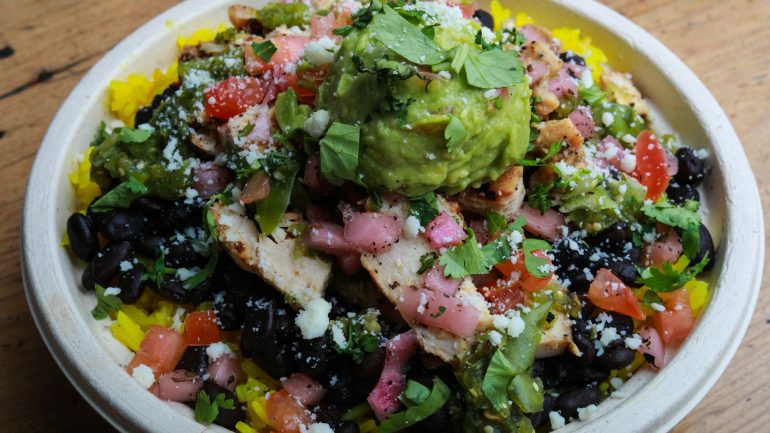
So the order worth repeating is brown rice, black beans, chicken, fajita veggies, fresh tomato salsa and guacamole. It’s about 795 calories and has a good amount of protein (47 grams!) and fiber (17 grams!). The sodium’s not ideal, but it’s not crazy (about 1,780 mg). Basically, those 4-5 items do most of the heavy lifting.
Find a bowl you’re happy with and make it your default, as you’ll save yourself some time and mental energy in the future by not having to make a decision each time you’re standing in front of the counter.

Cory Jones has spent 20 years in media and publishing and now leads the data and editorial operation behind The Greenest. He built and maintains the site’s Neighborhood Wellness Score — a proprietary dataset scoring food access, walkability, air quality, healthcare access, and health outcomes across 18,356 U.S. ZIP codes, drawing on CDC PLACES data, EPA air quality readings, and verified location intelligence. He turned 50 last year, is a huge fan of Rancho Gordo beans, and tries to work out more than he actually works out.
Is your neighborhood healthy?
Get a free report on your tap water, air quality, walkability and more