There’s an old Eddie Murphy joke about when he was very young he wanted to go to McDonald’s to get their hamburger (which was his favorite.) But his mom told him that she could make a better hamburger than McDonald’s at home.
And not to rehash the whole bit, but unsurprisingly young Eddie ends up crying because his mom’s burger (which has — gasp — green onions and an egg in it) tastes nothing like McDonald’s. And that’s how I used to feel about homemade “natural” cleaners. “Are these really cleaning anything?” I would ask myself. Isn’t cleaning product creation something we should leave to the experts and chemists of the world?
But that’s changed.
After doing a little research you start to understand that mixing your own natural cleaners is actually really easy. And they are surprisingly effective at cleaning a wide range of traditional household chores.
And it becomes an easier decision when you start to look at the ingredients on the back of most cleaning products. When you see the word “fragrance” that can actually mean one chemical or hundreds of chemicals. And the manufacturers aren’t required to tell us how much of each.
And the typical cleaning product has around 10 chemical compounds. The homemade ones in this article have three to five. And you are very familiar with all of them.
How hard is it? Literally five minutes of mixing in most cases.
“Typically a lot of the exposures that we see at poison control skew towards pediatric patients, but this is one where the majority of cases are in adults and the majority of cases are unintentional.”
— Dr. Kelly Johnson-Arbor, Medical toxicology physician and interim executive director, National Capital Poison Center
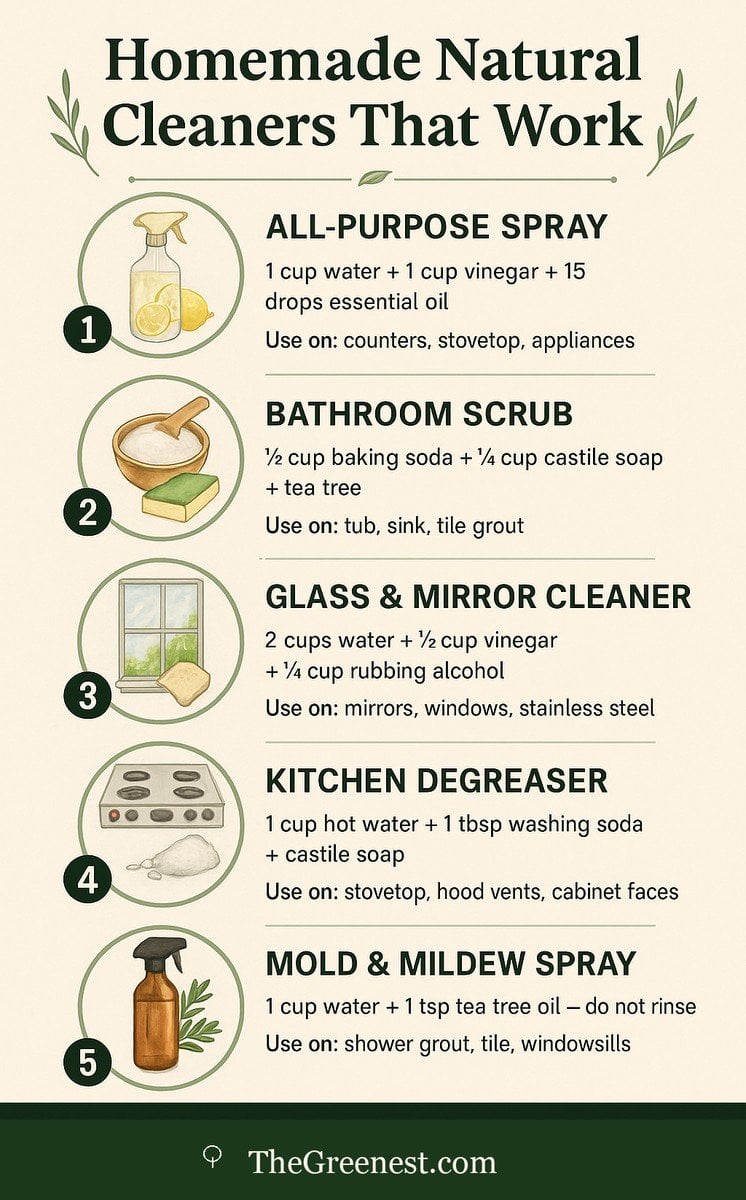
Want the recipes on one page? The full cheat-sheet graphic is waiting at the bottom of this list.
1. All-Purpose Spray

Everyone has their go-to spray bottle for a wide range of surfaces. This is great for everything from countertops and stovetops to that weird stain that’s been in the fridge for months. This works so well because the acid in the vinegar breaks the grease molecules and the essential oil adds real antimicrobial cleaning.
“A blanket statement is don’t mix bleach with other household chemicals.”
— Kaitlyn Brown, PharmD, Clinical Managing Director, America’s Poison Centers
🧴 The Recipe
All-Purpose Spray
- 1 cup water
- 1 cup white vinegar
- 15 drops lavender or tea tree essential oil
It doesn’t get much easier than this. Put all the ingredients in a spray bottle and just make sure you shake before each use. Then let it sit for 30 seconds after you spray, give it a wipe and you’re good to go. Microfiber cloths work great with it.
“You should never mix vinegar with chlorine bleach. The combination creates highly irritating chlorine gas.”
— Mary Elizabeth May, RN, BA, MPH and William G. Troutman, PharmD, Certified Specialist in Poison Information (May); Professor of Pharmacy Emeritus (Troutman) — National Capital Poison Center
One important exception: Do not use this on natural stone (granite, marble, travertine). Vinegar is acidic and will etch the surface over time. Use plain castile soap and water on stone counters.
- Bragg Organic Apple Cider Vinegar — Works as a cleaning vinegar; high acidity, no mystery additives
- Glass Spray Bottles (2-pack) — Essential oils degrade plastic over time; glass bottles last indefinitely
2. Bathroom Scrub

When combined, castile soap and baking soda do basically the same thing that commercial bathroom scrubs do. But one big difference: they do it naturally. The paste consistency lets it cling to vertical surfaces — grout lines, tub walls, sink edges — while the tea tree oil handles mildew at the source.
🧴 The Recipe
Bathroom Scrub
- ½ cup baking soda
- ¼ cup liquid castile soap
- 10 drops tea tree essential oil
Stir all the ingredients together until they form a thick paste. Then use a sponge or an old toothbrush to apply it to the grout and other areas you’re looking to clean. (Helpful tip: Do NOT use your current toothbrush. LOL).
Let it sit for 2–3 minutes on stubborn stains, then scrub and rinse. This can work on fine porcelain or those forever-stained fiberglass shower walls.
Store leftover paste in a small jar with a lid. It keeps for several weeks at room temperature.
- Dr. Bronner’s Pure-Castile Liquid Soap (Unscented) — Unscented gives you full control over fragrance via essential oils
- Arm & Hammer Baking Soda (8 lb bag) — Bulk sizing makes the math pencil out quickly
3. Glass and Mirror Cleaner

A lot of people have complained that homemade glass cleaners leave streaks. Well, this mixture fixes that. How? The classic homemade streak problem was due primarily to soap residue. And since this recipe has zero soap…voila! Problem solved.
And not to brag, but this mixture can consistently get your bathroom mirrors and other glass tops clearer than Windex. (This is anecdotal, there’s no research done. Just what we’ve experienced!)
🧴 The Recipe
Glass and Mirror Cleaner
- 2 cups water
- ½ cup white vinegar
- ¼ cup rubbing alcohol (70% isopropyl)
Combine these ingredients into a spray bottle. And then just use as normal. Except while lint-free cloths are great, a crumpled newspaper also works really well because it has a little extra texture that gets things clean without the lint.
This also works well on stainless steel appliances — spray, wipe with the grain.
- Glass Spray Bottles (2-pack) — Rubbing alcohol can degrade cheap plastic sprayers; glass holds up
4. Kitchen Degreaser

This is for those big grease jobs. The stovetop, the hood vent which, to be honest, I’m not sure I’ve ever cleaned, and the other greasiest areas of the kitchen. This is where the alkalinity of washing soda comes in handy.
🧴 The Recipe
Kitchen Degreaser
- 1 cup hot water
- 1 tablespoon washing soda
- 1 teaspoon liquid castile soap
Make sure you dissolve the washing soda in hot water before adding the castile soap to prevent clumps. Transfer to a spray bottle. Spray it onto any greasy surface, let sit 3–5 minutes, then wipe with a damp cloth. You’ll be surprised how easy it comes off.
Note: Washing soda can irritate skin with prolonged contact. Wear gloves when using it on heavy-duty cleaning tasks.
- Arm & Hammer Super Washing Soda — The go-to for laundry and heavy cleaning; widely available and inexpensive
- Dr. Bronner’s Pure-Castile Liquid Soap (Unscented) — Pairs well with washing soda without adding synthetic fragrance
5. Toilet Bowl Cleaner

This is a fun one because mixing baking soda and vinegar causes a nice little fizzing reaction. And as we learned when we were younger, the fizzing means it’s working. (Remember “scrubbing bubbles”?)
🧴 The Recipe
Toilet Bowl Cleaner
- ½ cup baking soda
- ¼ cup white vinegar
- 5 drops tea tree essential oil (optional, for extra antimicrobial action)
This is where sequencing also matters. Start by tossing some baking soda into the toilet bowl and then pour in the vinegar. It should immediately start fizzing. Then just walk away for 10 minutes.
Or you could stand there and look at it if you want. We won’t judge. If you want a little extra antimicrobial (and who doesn’t, it is your toilet after all) add in the tea tree oil.
Then scrub with a toilet brush like you would any other cleaner and give it a flush.
If you have hard water stains, put a little white vinegar on that and let it sit overnight. Give it a scrub in the morning and it should come right off.
- NOW Tea Tree Essential Oil (4 oz) — High-quality, unadulterated tea tree oil at a reasonable price per ounce
6. Mold and Mildew Spray

Making your own mold and mildew spray really just comes down to having some tea tree essential oil and water. Couldn’t be simpler.
Tea tree oil’s antifungal properties were proven in a study published in the Journal of Applied Microbiology. They found that tea tree oil really did a number on a range of mold species.
It’s great for bathroom tile grout, shower walls, and window sills.
🧴 The Recipe
Mold and Mildew Spray
- 1 cup water
- 1 teaspoon tea tree essential oil
Just put this into a glass spray bottle and make sure you shake well before each use. Spray it on the mold or mildew and walk away. Specifically, do not rinse! Tea Tree oil needs a bit of time to do its job. And don’t worry about the odor, that will dissipate in a couple hours.
For black mold on larger surfaces, this spray is a maintenance tool, not a remediation solution. Significant mold growth covering more than 10 square feet typically warrants professional assessment.
- NOW Tea Tree Essential Oil (4 oz) — Third-party tested, consistent potency — important when you’re relying on it for antifungal action
7. Floor Cleaner

Despite being your most dirt-worn surfaces, floors typically do pretty well with a traditional diluted vinegar solution. Ironically, soap-based floor cleaners usually leave a soapy film that ends up attracting more dirt.
🧴 The Recipe
Floor Cleaner
- ½ cup white vinegar per gallon of warm water
- 10 drops lavender or lemon essential oil (optional, for scent)
Put this into a bucket and mop like you normally would. The vinegar smell will be gone in 15 mins. If your floor is really dirty increase to one cup per gallon of water.
Important exception: Do not use vinegar on hardwood floors. The acidity will dull the finish and eventually damage the wood itself. For hardwood, use a small amount of castile soap diluted in water (1 teaspoon per gallon), wring the mop almost dry, and clean in the direction of the grain.
- Plant Therapy Lavender Essential Oil — Clean floral scent that transforms the mopping experience without synthetic fragrance
8. Laundry Powder

Making your own homemade laundry detergent can save some serious bucks over time. Commercial laundry detergents usually come out to 20-40 cents per load. But this laundry powder is around 5 cents per load.
🧴 The Recipe
Laundry Powder
- 1 cup washing soda
- 1 cup baking soda
- ½ cup liquid castile soap (or a grated bar, if you prefer powder form)
- 20 drops essential oil (lavender, lemon, or eucalyptus)
One note here, if you’re using the liquid castile soap, make sure to mix the dry ingredients first, and then drizzle in the soap while stirring. Almost like you’re making a vinaigrette. And just use 2 tablespoons per load. For heavily soiled laundry, add ½ cup baking soda directly to the drum before loading clothes.
This formula works in both cold and warm water, though warm water helps the washing soda dissolve more effectively in HE machines with low water volume.
- Arm & Hammer Super Washing Soda — The backbone of this formula; no viable substitutes
- Arm & Hammer Baking Soda (8 lb bag) — Buying bulk dramatically improves the cost-per-load math
The 5 Base Ingredients For All of These Recipes

You’d be surprised how common most of these ingredients are. You can find them at almost any hardware or grocery store. The majority of the recipes below use the same five workhorse ingredients:
- White vinegar — White vinegar cuts through grease and kills a lot of common bacteria. Mostly due to its acetic acid content. You can up the power by using a cleaning-grade vinegar, which has 6% acidity for tougher jobs.
- Baking soda (sodium bicarbonate) — Need a bit of scrubbing? Baking soda is a nicely mild abrasive that can get off gunk without scratching surfaces. It also is a strong odor absorber.
- Castile soap — This is what Dr. Bronner’s soap is. It’s made from olive or coconut oil, but it is a great getter of grease and dirt. And it’s not synthetic or petroleum based.
- Washing soda (sodium carbonate) — This is close to baking soda, but it’s a bit stronger. It can cut pretty heavy grease and is great for laundry. Arm & Hammer makes a widely available version.
- Tea tree oil — Got mold? Tea tree oil is a great antifungal and antibacterial. And it’s great at targeting the most common mold-causing fungi. You don’t need a lot to make it work, either.
Stock these five, and you can make everything below.
Important: What Not to Mix
A few combinations are genuinely dangerous — not “might irritate skin” dangerous, but “produces toxic gas” dangerous:
- Bleach + vinegar — Produces chlorine gas. Even small amounts in an enclosed bathroom can cause respiratory damage.
- Bleach + ammonia — Produces chloramine vapor. Many commercial glass cleaners contain ammonia — read labels before mixing anything with bleach.
- Vinegar + hydrogen peroxide (in the same container) — Separately, both are useful cleaners. Combined, they form peracetic acid, which is corrosive to skin and lungs at higher concentrations.
None of the recipes above contain bleach. If you use bleach elsewhere in your home, keep it entirely separate from these formulas. When in doubt, rinse a surface thoroughly before applying a different cleaning agent.
“People should only use cleaning products as directed on the package label, and only for the way that they’re meant to be used.”
— Dr. Kelly Johnson-Arbor, Medical toxicology physician and interim executive director, National Capital Poison Center
Isn’t it surprising how many of these homemade cleaners use very common ingredients that you probably already have around the house? And if you don’t have them, they aren’t hard to find.
The only thing you’ll likely need is a few more spray bottles. But those are also easy to find. Give a few of these a try and let us know if you have your own formula that we don’t have here and we’ll add it to the list.

Cory Jones has spent 20 years in media and publishing and now leads the data and editorial operation behind The Greenest. He built and maintains the site’s Neighborhood Wellness Score — a proprietary dataset scoring food access, walkability, air quality, healthcare access, and health outcomes across 18,356 U.S. ZIP codes, drawing on CDC PLACES data, EPA air quality readings, and verified location intelligence. He turned 50 last year, is a huge fan of Rancho Gordo beans, and tries to work out more than he actually works out.
Is your neighborhood healthy?
Get a free report on your tap water, air quality, walkability and more