So many things get sold as anti-aging these days. Whether it’s collagen, elastin, some fruit you’ve never heard of, red lights etc. The list goes on and on. The truth is, very few things have actually been tested on human faces.
And people spend so much money on trying to look better and/or younger. Let’s not forget botox and face lifts that have become much more acceptable these days. But very few people talk about what you eat as a way of keeping yourself young and fresh faced.
Healthy foods make sense to be part of the anti aging conversation (which reminds me of the Seinfeld episode where Kramer starts smoking cigars and his face ends up looking like a “catcher’s mitt.”)
Lifestyle choices can have a big impact on how you look!
Skincare gets most of the anti-aging attention, but dermatologists keep pointing at the plate. “Don’t underestimate the power of a reasonable diet and balanced nutrition as a measure for preventing aging and prolonging one’s life,” says board-certified dermatologist Andrea Suarez, MD, who puts it more bluntly elsewhere: “When you have a crappy diet, it shows up on your face.”
The one caveat about the list below, there’s not a ton of research on how food affects your face. It doesn’t mean that there’s zero, but there isn’t reams of clinical trial data. In short, the science behind how food can impact your face really comes down to sugar.
Sugar attaches itself to the collagen and elastin in your skin and ends up essentially breaking them down. And the more collagen and elastin you have the better you’ll look. So eating foods that help with blood sugar not only help with things like diabetes, but can make you look younger, too.
The Food That Ages Skin Fastest: Sugar
As much as it tastes great, and makes everything it touches taste even better, sugar is bad for your skin. There’s no doubt about it. And it’s bad for a lot of other parts of your body.
But specifically for your skin, sugar intake creates a process called glycation. And glycation is when sugar grabs the good stuff in your skin (collagen, elastin etc) and basically starts to kill it. This is why high-glycemic foods can cause a wide range of skin issues.
While it tastes great (and let’s not kid ourselves, we need to treat ourselves from time to time) sugar takes things away in your body. It makes a lot of things work harder and that can have an effect.
“If you eat or drink too many refined carbs and sugars, it can lead to a process called glycation in the skin,” says dermatologist Whitney Bowe, MD. “Glycation is when sugar attaches to proteins in the skin like collagen and elastin, and targets them for destruction.”
NYC dermatologist Joshua Zeichner, MD, names the usual culprits: “Refined carbohydrates, such as white bread, are one of the biggest contributors to glycation, a process where sugar attaches to collagen.” And dermatologist Debra Jaliman, MD, keeps it short: “High-glycemic foods are known to cause acne and wrinkles.”
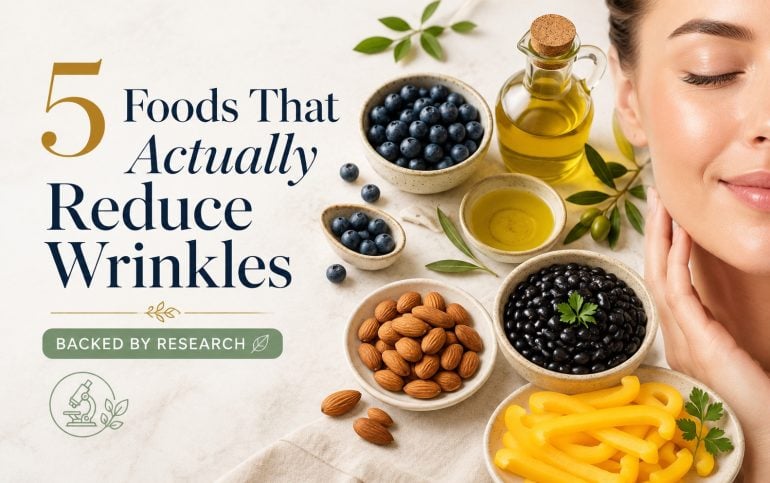
5. Beans

Beans are so good for you, they should be on nearly every one of your plates. They offer so much (and they are great for the environment to boot.) But when it comes to your skin, they really provide the building blocks for the things your body needs to give your skin everything it wants.
“Beans are a plant-based source of lysine, proline, and glycine, three amino acids that are key for collagen synthesis,” says Razan Hallak, MS, RDN, and as dietitian Jessica Zinn, MS, RD, explains, “your body uses these amino acids to form the long chains that create collagen’s triple-helix structure, supporting skin elasticity and connective tissue strength.”
The thing about beans is that the more you eat of them, the less you are likely to eat of unhealthy stuff. And they are great for blood sugar spikes that increasing beans should decrease blood sugar spikes, which will have an impact on your collagen and elastin.
4. Berries

Berries are another food that is great for you. There is a small study on rats (not humans) that showed an increase in the rats collagen and elastin. (Those rats looked great at the end of that study lol.)
But here’s the thing. Small studies like this become the start of huge marketing campaigns claiming berries make you look younger. None of that is proven right now. But should you eat more berries?
Yes. Plus, berries pull double duty: “Berries contain antioxidants, which can help preserve the collagen already in the skin,” says Diana Guevara, MPH, RD.
3. Salmon

Salmon and other fatty fish are another one of those anti-aging adjacent foods. Omegas-3s are great for inflammation and helping your skin put up a healthy moisture barrier against bad stuff. But no one has tested whether it reduces wrinkles.
So anyone who claims that fatty fish will decrease wrinkles is lying. But having said that, the omega-3s in fatty fish do some things that can help your skin. Also, they are really good for you.
So why not have more salmon? Dietitian Samantha DeVito, MS, RD, notes it’s “rich in omega-3 fatty acids, which help reduce inflammation and can support the skin’s moisture barrier.”
Source: Potential Uses of Omega-3 Fatty Acids in Dermatology: A Review, 2020
2. Citrus

The science here is also similar to salmon. Vitamin C is good for collagen. it’s one of the things that helps it create good collagen (not defective collagen.) The difference here is that “your body can’t do this” vs “it will make you look younger” are two different things.
And while it’s a good idea to give your body the tools to make more good collagen, there’s no guarantee that it will remove wrinkles. “Citrus fruits are generally rich in vitamin C, which is an essential cofactor for collagen production,” says registered dietitian Maxine Yeung, MS, RD. “Without enough vitamin C, the body does not produce the type of collagen needed to support healthy connective tissue.”
Source: The Roles of Vitamin C in Skin Health, Nutrients 2017
1. Almonds

So almonds have actual data that shows they have a direct link to helping remove wrinkles. With one caveat. The controlled trial that showed they removed wrinkles was funded by…you guessed it…the California Almond Board.
So take that for what it’s worth. “Almonds are actually rich in vitamin E. It incorporates into the lipid membranes around skin cells and sits there ready to fight off those reactive oxygen species that would otherwise damage lipids,” Dr. Suarez says, pointing to a controlled trial where “photographic evaluation of their wrinkles showed there was a nine percent decrease in wrinkles compared to baseline in the group getting almonds.”
Source: Prospective RCT on the Effects of Almonds on Facial Wrinkles and Pigmentation, Nutrients 2021
The Five, Ranked by Evidence
| # | Food | What the evidence is | Source |
|---|---|---|---|
| 1 | Almonds | Two RCTs measuring wrinkles | study |
| 2 | Citrus | Required cofactor; no wrinkle trial | study |
| 3 | Salmon | Reviews; no wrinkle outcome | study |
| 4 | Berries | Cells and rats, not people | study |
| 5 | Beans | Mechanism only; no trial | — |
The Bottom Line
After doing the research, what we’ve learned is that good food more often than not can provide your body with the building blocks of helping with wrinkles. There’s not enough data out there to prove a “eat this and then you’ll have no more wrinkles” theory.
But we do recommend eating more of the foods above to give your body the best chance to look its best. Plus they’re all good for you, which will help other parts of your body.
“There isn’t some glamorous single-product game-changer when it comes to boosting collagen,” says Maddie Pasquariello, MS, RD. “It’s all about the larger picture of your diet.” Or, as Yeung sums it up: “You can support your body’s natural collagen production by eating a variety of nutrient-dense foods, getting enough protein and including fruits and vegetables high in vitamin C.”

Cory Jones has spent 20 years in media and publishing and now leads the data and editorial operation behind The Greenest. He built and maintains the site’s Neighborhood Wellness Score — a proprietary dataset scoring food access, walkability, air quality, healthcare access, and health outcomes across 18,356 U.S. ZIP codes, drawing on CDC PLACES data, EPA air quality readings, and verified location intelligence. He turned 50 last year, is a huge fan of Rancho Gordo beans, and tries to work out more than he actually works out.
Is your neighborhood healthy?
Get a free report on your tap water, air quality, walkability and more